The hole where Borders was, and the dummies who dug it


Writers hate the idea of slush piles, where agents and editors dump unpublished works. On the last weekend of business at Borders in Philadelphia, I saw the equivalent of a slush pile for published works.

It wasn’t a pretty sight. The titles, all marked down by 80 percent, included Norah Marler’s No More Dating Pigs, Suzan Hilton’s Feng Shui, Seth Meyers’ Dr. Seth’s Love Prescription, Susan Boyle’s Dreams Can Come True. There was Lacrosse for Dummies and titles by Sarah Palin, Mike Huckabee, Bill O’Reilly and other contemporary sages.

That’s a small sampling. The store was jammed with books no one would want, even if they’d been marked down 100 percent. The scene was a testament to the mind-boggling number of bad books in print and to the waste of enormous amounts of money by publishers, not to mention waste of trees.

It was a reminder that, in the not-too-distant future, the books industry will be selling more e-books than new printed books. Publishers and distributors can’t hurt themselves making stupid guesses about press runs for e-books. They provide exactly as many e-books as the public demands, and consequently will clear higher profits as book buyers become hooked on the e-reading habit.

Did I mention this is some depressing shit? I can get used to a world with a dwindling number of bookstores, just as I got used to fewer record stores, no video stores and almost no decent movie theaters. But it’s hard to imagine a world without these destinations as anything but diminished, especially in regard to in-person social interaction.

Footnote: Ideally, the three-story corner space in the heart of Center City where Borders was would become another bookstore, but this time with smarter owners — for instance, the people at Joseph Fox Bookshop. (“Distant Star by Roberto Bolano? Not in stock but we can have if for you by 11 a.m. tomorrow, sir.”) But Fox would have to invent its own e-reader to compete with the surviving monster chains.

The bottom-liners who own the former Borders building — they’re in New York — will simply rent it to the highest bidder, regardless of whether that bidder’s business is as good a fit for the area as a bookstore-coffee bar-eatery.

And this: Ever wonder about the dim bulbs at the top who make the disastrous decisions, or non-decisions, that ultimately drive good businesses into bankruptcy? You don’t have to — they almost always land on their feet in new executive positions, as opposed to rank-and-file employees, who end up jobless. Ironically, there were probably a dozen employees at Borders Center City — people who actually work with customers — who knew years ago that the execs were making a big mistake by not confronting the challenges posed by Amazon and, much later on, by e-books.

The chiefs in the chain were probably too busy gambling on new acquisitions to check on the health of what they assumed was a herd of cash cows.
Posted in arts, Great Recession, livable cities, Philadelphia, unemployment, Wall Street | Tagged , , , , , , , | Leave a comment

‘Low-stoop’ fiction writer seeks agent, brand


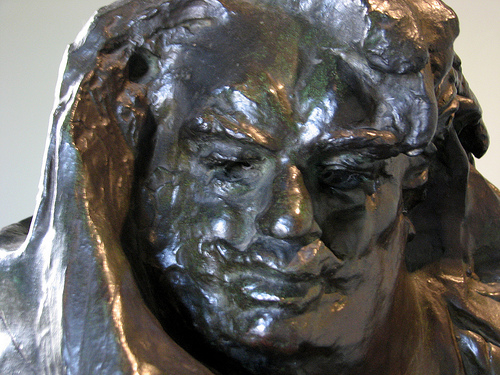
Balzac at the Rodin Museum in Philly

Citations from an article about the importance of tireless self-promotion in trying to establish a brand for your work:

For artists, the great problem to solve is how to get oneself noticed.

— Honore de Balzac, Lost Illusions

Great success is not possible without a certain degree of shamelessness, and even of out-and-out charlatanism.

— Stendhal, Memoirs of an Egotist

I slacked off blogging this month, mostly to focus on my manuscript, from the Latin manu scriptus, “written by hand.” A funny word, because nobody writes anything by hand anymore, and because it connotes the promise of special knowledge or even wisdom. “I sent the whole manuscript to an agent,” a fellow writer said to me the other day in a self-reverential tone that made me think of the Dead Sea Scrolls.

A doubly funny word because, on any given day, thousands of fiction writers seek agents for their manuscripts, and we aren’t talking precious scrolls here. Most manuscripts end up in so-called slush piles. Increasingly, virtual manuscripts are assigned to virtual slush piles.

And yet writers persist, mainly because we’re egotists, as Stendhal noted. We think our manuscripts will be embraced if only the world can get a look at them. We know we’re one lucky break away from gifting Western civ with something as enduring as The Red and the Black.

I exaggerate, but you get the point. We want to be read.

Sometimes a writer breaks through to an agent who may actually skim a manuscript because of a clever cover letter or an influential intermediary and then try to “place” the thing because he/she likes it and thinks it might be salable. As a last resort, there’s self-publishing — you will read my stories, damn it, even if I have to peddle them personally!

For the record, I haven’t yet sent my manuscript — a collection of short stories called Idiot Lights — to any agents, but rather to an English professor friend for suggestions and, most importantly, praise, whether or not it’s deserved. I’m pitching individual stories to magazines.

I harbor no illusions. None of my stories will find a champion at the New Yorker, and they’re much too raw for whitebread literary publications such as… I won’t drop names, there’s always the chance someone actually reads these posts.

Let’s just say my stories have provoked mixed reactions among the few people who’ve read them. My favorite was a workshop leader in New York who’d made a name for himself working with a famous minimalist short story writer. He said my characters are “low-stoop,” meaning low-class — pimps, junkies, psychos, whores, musicians, produce vendors and so on — and that my fiction therefore wouldn’t appeal to middle-class readers, the group that buys the most books.

What could I say? One writes what one knows, and I think there’s an audience somewhere for my low-stoop fictional friends. One of these days an agent will agree and it will on my head to push push push to establish recognition and sales, so I’d better start practicing now.

Or maybe not — “It’s a crap shoot,” as my professor friend says — and I’ll try to worm my way back into copywriting and PR. Hey, where do you think I learned so much about pimps and whores?

Posted in arts, fiction, mainstream media, Philadelphia | Tagged , , , , , , , , , , | 1 Comment

Again, Bernie plays the Obama we thought we elected


This from Bernie Sanders, who stands out from most of his fellow U.S. senators like a St. Bernard in a pack of toy poodles:

The United States is the only major nation in the industrialized world that does not guarantee healthcare as a right to its people. Meanwhile, we spend about twice as much per capita on healthcare and, in a wide number of instances, our outcomes are not as good as others that spend far less. It is time that we bring about a fundamental transformation of the American healthcare system. It is time for us to end private, for-profit participation in delivering basic coverage. It is time for the United States to provide a Medicare-for-all, single payer health coverage program.

The key word is “basic.” Sanders thinks most Americans are smart enough to understand the most important step toward reform is to eliminate the middleman; to provide an option that doesn’t involve for-profit private companies — Aetna and so on — that have made our healthcare system an international joke. He knows we don’t like this system, that it only thrives because insurance companies pay politicians big bucks to maintain the status quo.

That’s why Sanders just introduced a bill that would do for the nation what single-payer health insurance is doing for Sanders’ home state of Vermont — lowering costs while providing care for all who may need it.

A companion bill to Sanders’ was introduced in the House by Rep. Jim McDermott, a long-time advocate of health insurance reform who stands out from most of his House colleagues like a Great Dane in a pack of… I’d say rat terriers, but rat terriers have more courage than congresspeople.

If the new legislation were to miraculously come to fruition it would be a big improvement over Barack Obama’s health reform law, which provides coverage for 32 million more Americans but does not cover 23 million others. And the new law does nothing to bring down soaring healthcare costs.

Ironically, Republican corporatists scornfully refer to the reforms as Obamacare, as if they’re a radical departure from the old healthcare system instead of a watered-down version of reform that makes insurance companies richer than ever.

Which only goes to show that half-measures usually earn you nothing but contempt from legislators determined to never give an inch on issues crucial to the continued outlandish profits of the companies that own them.

One can only wonder what would have happened if Obama had fought for single-payer insurance — i.e., taken the issue to the American people in a series of appearances and speeches — or for the so-called public option, a government-funded alternative to the private insurance companies.

Instead, he caved to right-wing demands before demands were even made, possibly because of advice from dirtbags such as Rahm Emanuel, who called Dem advocates of the public option “fucking retarded.” Or because Obama himself simply wasn’t into significant healthcare reform, just as he wasn’t into ending bonus tax cuts for the rich, backing labor unions, creating jobs programs for the unemployed or taking steps to discourage outsourcing of what used to be American jobs.

OK, it’s all water under the bridge. But it’s good to know there are still a few public servants who fight the good fight instead of surrendering without firing a shot. And that’s enough cliches for one column. Go Bernie!

Posted in Congress, globalization, Great Recession, health care, Obama, Politics, unemployment | Tagged , , , , , , | Leave a comment

What does ‘killing evil’ mean, Maureen?


Here’s the Beltway sage Maureen Dowd, defending those who danced in the streets and shouted “USA!” at the news that Osama bin Laden had been killed by the U.S. military:

I don’t want closure. There is no closure after tragedy. I want memory, and justice, and revenge. When you’re dealing with a mass murderer who bragged about incinerating thousands of Americans and planned to kill countless more, that seems like the only civilized and morally sound response.

I don’t want closure either. It’s a meaningless concept in the real world, where cause and effect ripple through all of our actions. All I want is some intelligent discourse in the mainstream media, where almost all opinion pieces are written by hacks such as Dowd, who can always be counted on to poke fun at the Washington D.C. establishment without ever — not once — writing from a point of view outside the narrow range of opinions acceptable to that establishment.

Dowd is either too dishonest or too feeble-minded to address the implications of her gung-ho remarks about bin Laden. In World War II, Gen. Curtis “Bombs Away” LeMay gave the order to incinerate not thousands, but hundreds of thousands of civilians in the air war against Japan. And this was before nukes were dropped on Hiroshima and Nagasaki. Wouldn’t the only “morally sound” response to LeMay’s savagery have been to kill him by whatever means necessary? Or was his savagery morally sound because Americans were the good guys?

Similarly, Richard Nixon and Henry Kissinger, from 1969 to 1973, secretly and illegally ordered air raids in Cambodia that killed a half-million civilians and led to the takeover of the country by the Khmer Rouge, who subsequently massacred millions. (Sideshow, by William Shawcross, is the book to read.)

Nixon lived long enough to partially “rehabilitate” his reputation. Kissinger, arguably the most well-known living mass murderer, is regarded as a respected elder statesmen by much of the mainstream press. But wouldn’t it be morally sound to indict and prosecute Kissinger for his well-documented crimes?

And what about George W. Bush and Dick Cheney? Wouldn’t it be morally sound to bring charges against them for misleading America into a war in Iraq that resulted in hundreds of thousands of civilian deaths? There are prosecutors in Europe who think so. Both men know they might end up in jail if they were to set foot in some civilized country where jurists don’t turn a blind eye to the crimes of the rich and powerful.

The headline on Dowd’s column was “Killing evil doesn’t make us evil.” This is a silly pronouncement (how does one “kill” evil, a force stoked by killing?) that assumes a conveniently reductive definition of evil. History has shown that people often become so convinced of their own inherent goodness that they fail to recognize the point at which their conduct makes them no better than their enemies.

Midway through her column, Dowd writes, “I leave it to subtler minds to parse the distinction between what is just and what is justified.”

Too bad she didn’t take her own advice. And too bad NYT editors are too intellectually lazy — or, more likely, too cowardly — to publish op-ed pieces on such a serious subject by writers who don’t stoop to using the written word to wave the flag.

Posted in Iraq war, mainstream media, New York Times, New York Times op-ed, Politics | Tagged , , , , , , , , | Leave a comment

Osama, we hardly knew ye!


Put on your waders, here comes the presidential bullshit:

Tonight, let us think back to the sense of unity that prevailed on 9/11. I know that it has, at times, frayed. Yet today’s achievement is a testament to the greatness of our country and the determination of the American people.

For almost a decade, the mainstream media obediently served up government lies concerning the whereabouts of Osama bin Laden. The criminal mastermind was holed up in a cave on the Afghan-Pakistani border. He was dashing from mountain to mountain with U.S. Army Rangers in hot pursuit. He was in a tent somewhere, on a dialysis machine, surrounded by bazooka-toting lookalikes. He was dead and buried at Tora Bora.

In the end, he was “found” and killed by Navy SEALs 60 miles from the Islamabad, the capital of Pakistan, where he’d been living in a mansion/compound. Now all we’re hearing from the media, aside from clips of politicians spewing victory speeches, is that U.S. forces acted on a tip about bin Laden’s whereabouts that was confirmed back in August.

If you believe we had to be tipped off by a third party, then you probably believe humans and dinosaurs roamed the earth together, as they do at that theme park in the Bible Belt.

If you think the Pakistanis didn’t know exactly where bin Laden was years ago, or that the U.S. didn’t have to cut a deal with them to get to him, then you’re even dumber than Wolf Blitzer. (Last night, the hoary CNN host exclaimed “who would have thought” bin Laden would be found living in luxury under the noses of our allies.)

Finally, if you think bin Laden’s terror attack on 9/11 didn’t spark exactly the responses he’d hoped for — two disastrous ongoing wars that have killed hundreds of thousands, and helped destroy our credibility and erode our constitutional rights — then you probably believe what you hear in the media or from blowhards masquerading as political leaders.

Have fun, news junkies. Over the next week, mainstream reporters will crank out thousands of dispatches about bin Laden, mostly infotainment from government sources. The real news will remain locked in a cool, dark place, far from the not-so-free and extremely timid press.

Posted in economic collapse, Great Recession, Iraq war, mainstream media, Obama, Politics | Tagged , , , , , , , , | Leave a comment

A Python-esque rite in South Philly


Always look on the bright side, my homeys.

Ah, the rites of spring in the `hood! You know — palm weaving, the Easter Parade on South Street, race riots in Grays Ferry. Here’s one that was new to me — the Good Friday re-enactment of the crucifixion of Jesus, outside the Annunciation B.V.M. Church at 10th and Dickinson streets, with a large crowd of Latinos that included rosary-clutching women and some men in plumed helmets, toting spears.

Not so long ago Annunciation was on its way to becoming pretty vacant, as the Sex Pistols would say. Many parishioners in the once heavily Italian neighborhood had died off or moved to places like Washington Township, NJ, aka Little South Philly. But then came the large influx of Latinos into the area.

Many of these Latinos do the grunt work in local restaurants or have helped keep the Italian Market neighborhood alive by starting their own businesses, some of which remain open after dark, a concept the old merchants on Ninth Street never warmed up to.

According to the latest census, the influx of Latinos and Southeast Asians has helped stop the decline in South Philly’s population. Their presence here has angered Joey Vento, owner of Geno’s Steaks, and suburban Tea Party types who blame recent immigrants for lost American jobs because they don’t want to understand how we’ve all been screwed by Wall Street and corporate outsourcing.

I’m off-topic, as usual… What a versatile word, crucifixion. Lindsay Lohan and Tiger Woods have described themselves as crucified by the media. Tori Amos sang of crucifying herself for love. William Jennings Bryan warned that the U.S. would be crucified on a cross of gold.

But there ain’t nothin’ like the real thing, or at least a copy of the real thing. The Jesus impersonator, rather than hanging from nails driven into hands and feet, was standing on a platform and gripping metal rungs embedded in the cross. The crowd milled, presumably imagining the real Jesus dying in the hot sun, although it was cold and overcast, a bad day to be half-naked and immobile.

And what did the onlookers take away from this show? Maybe the old-time notion that Jesus died for their sins, or for somebody’s, and deserves some gratitude. (I think this was in the Book of Patti Smith.)

More likely, an earthly reminder that you can travel thousands of miles to escape poverty and prejudice and have to fight the same battles all over again in your new home. But also the semi-comforting thought that things could be worse, you might as well hang around for a while and, like Monty Python, look on the bright side of life.

Posted in economic collapse, globalization, Great Recession, immigration, livable cities, mainstream media, NJ, Philadelphia, Politics, Wall Street, world-wide economy | Tagged , , , , , , , , | Leave a comment

Brooks, the Earnest Weasel, nips at Obama


This because it’s been a long while since my last installment of the Weasel Watch:

President Obama and Paul Ryan are two of the smartest, most admirable and most genial men in Washington. It is sad, although not strange, that in today’s Washington they have never had a serious private conversation. The president has never invited Ryan over even for lunch. As a result, both men are misinformed about the other, and both have developed a cold contempt for the other’s position. Obama believes Ryan wants to take America back to what he sees as the savage capitalism of the 1920s (or even the 1760s). Ryan believes Obama wants to turn America into a declining European welfare state… If they met, would they resolve their differences? No, but they would understand them better.

David Brooks excels at pushing right-wing agendas while pretending to be the voice of moderation, the man in the middle. He trots out false equivalencies and flawed assumptions in support of his arguments, then pretends to be distressed by the partisanship of those who can’t match his magnanimity.

He is, as I wrote in January, the Earnest Weasel of American pundits,

tweaking an imaginary congregation of moral midgets who don’t understand how sinful it is to oppose, in an uncompromising way, those who would destroy not only the social safety net woven from the New Deal but also the political system that put the safety net in place.

The country will collapse, you see, unless we uphold civility in our debates, even when our opponent is a cold-blooded libertarian twerp — Paul Ryan, that is — who starts from the premise that budget reform is impossible without huge cuts in the funding of programs that help define what it means to live in a society built on humanist values.

Today’s dispatch by Paul Krugman — “Let’s not be civil” — implicitly dismisses the weasel’s false felicity. Obama lunching with the likes of Ryan is “a bad idea,” because the Republican budget proposal is irreconcilable with progressive, or even mildly liberal, notions of good government. It proposes that spending cuts “pay for tax cuts rather than deficit reduction. The transparent and obvious goal [is] to use deficit fears to impose a vision of small government and low taxes, especially on the wealthy.”

And yet the weasel would have readers believe that the gulf between ideologies is bridgeable; that it’s merely a question of how much spending on social programs must be cut, not whether such cuts are fundamentally wrong.

I wish Obama had Krugman’s clarity, or at least the willingness to act on some of the moral arguments he makes in his speeches.

From George Lakoff: “What is called a ‘tax break’ for the rich is actually a redistribution of wealth from the poor and middle class—whose incomes have gone down—to those who have considerably more money than they need, money they have made because of tax investments by the rest of America.”

Posted in David Brooks, economic collapse, Great Recession, mainstream media, Obama, Politics, taxes | Tagged , , , , , , , , | Leave a comment

In the neighborhood, in spring


Emerging from my bunker to chat with the neighbors (tonywoodphoto)

What’s he building in there?/What the hell is he building/In there?/He has subscriptions to those/Magazines… He never/Waves when he goes by/He’s hiding something from/The rest of us… He’s all/To himself… I think I know/Why…

Tom Waits

Overheard while running past a couple of old gents in South Philly: “Don’t worry about it, you’ll be alright. I’ve had dementia my whole life.”

This just after I step around a Lady Gaga clone walking a fur-clad dachshund and say hello to my neighbor T., who sells antiques on the street and plays Verdi at full volume and is convinced it’s only a matter of time before the Colombian mob takes him out.

On my home street the girls next door, a cheerful gang of beer-drinking Roller Derby fans, are playing cornhole, an unfortunately named variation on horseshoes that involving two teams trying to toss sacks of pebbles into small round holes in freestanding wooden platforms. Other neighbors are watching from their folding chairs — the ex-Army Ranger and his psychologist wife, the guitarist, the woman who talks like Roseanne Barr, the director of absurdist plays who wears sensible shoes.

And the dogs, of course. There are few kids but dogs, the focal point of socialization on this street, are everywhere. From a distance, it looks like the whole gang, the neighbors and their dogs, are preparing for a midday hunt.

I say hi to my neighbors and they say hi to me, and we chat. I pet an over-friendly dog and duck into my bunker to get some work done. My neighbors are ducking in and out of their bunkers, too. It’s an unexpectedly warm day and everyone is getting back into the swing of playing outdoors and gossiping.

Each of us is here for our collective amusement. What happened to Coyote Boy, our trash-picker neighbor, whose brother sold the house after their father died? Is Mrs. R dead or did her kids put her in a home? Is D working? What happened to the woman he used to brawl with? Did he bury her in his basement?

Later I’ll ride my bike to a bookstore in West Philly and notice all the trees have suddenly sprouted pink or white blossoms and are arching over the streets like twin rows of bouquets. I’ll deduce from this, and from the reappearance of my neighbors, that it’s time to write a story about spring.

Posted in arts, bicycling, livable cities, Philadelphia | Tagged , , , , | Leave a comment

A plague on Republicrats!


Will Barack Obama keep the promise he made today and oppose extending the Bush tax cuts next time? Will it even matter when the Republicans are finished screwing around with the tax code?

The ugly truth is that Obama and the Congressional Dems fled the field in advance of the main budget battle and are only skirmishing to save face at this point. Meanwhile, outrageous tax breaks for the richest one percent remain in place and quality of life for most people in this country continues to decline. As Joseph E. Stiglitz wrote in Vanity Fair:

… America has long suffered from an under-investment in infrastructure (look at the condition of our highways and bridges, our railroads and airports), in basic research, and in education at all levels. Further cutbacks in these areas lie ahead. None of this should come as a surprise—it is simply what happens when a society’s wealth distribution becomes lopsided. The more divided a society becomes in terms of wealth, the more reluctant the wealthy become to spend money on common needs. The rich don’t need to rely on government for parks or education or medical care or personal security—they can buy all these things for themselves. In the process, they become more distant from ordinary people, losing whatever empathy they may once have had. They also worry about strong government—one that could use its powers to adjust the balance, take some of their wealth, and invest it for the common good. The top 1 percent may complain about the kind of government we have in America, but in truth they like it just fine: too gridlocked to re-distribute, too divided to do anything but lower taxes.

Stiglitz was one of the first economists to clearly spell out the catastrophic long-range costs of the Iraq war — the first, I believe, to point out that the costs will exceed $3 trillion when care for badly injured veterans is figured in. He was more or less ignored on this issue, just as he’s being ignored on the catastrophic long-term costs of income inequality.

How often do Stiglitz’ common-sense conclusions about excessive wealth in the hands of a few come up in debates about the federal budget? The talk is all about spending cuts. Serious discussion in the White House, Congress and the mainstream media regarding the correlation between drastic cuts in taxes on the rich and the soaring national debt is non-existent.

Tax rates for the richest have been cut in half since the 1950s. Instead of working to reverse this, many D.C. Democrats — the very people we elected to protect our interests against the rapacity of the rich — are on the verge of voting to cut spending for the neediest and not even making the case that excessive tax breaks for the rich is one of the main drivers of the deficit.

We know where Republicans stand. It wasn’t until this year that we found out Dems in high places stand for the same thing: the prevention of fair taxation of the rich, even though this directly undermines the funding of education, jobs creation, infrastructure repair, environmental protection and other expenditures that would benefit the many rather than the few.

A plague on both your houses, Mercutio would say. Actually, it’s the same house — the house of the Republicrats. The only questions are 1) whether there exists a qualified Democrat or independent with the guts to oppose Barack Obama and take a shot at tearing down this house, 2) whether we can elect enough true Congressional progressives to make an actual difference when it comes time to rebuild.

Posted in economic collapse, finance reform bill, globalization, Great Recession, Iraq war, mainstream media, Politics, taxes, unemployment, world-wide economy | Tagged , , , , , , , | Leave a comment

Lumet’s gone, but ‘Network’ is forever


Reading of Sidney Lumet’s death, I thought of Al Pacino chanting “Attica! Attica!” to rouse the rabble in Dog Day Afternoon; of Henry Fonda, with Obama-like cool, shrugging off Lee J. Cobb’s bully tactics in Twelve Angry Men; of Jerry Orbach as a crooked New York cop raging against his fate in Prince of the City.

Lumet made more than a few great movies, but even his lesser films feature great scenes. He was a master of the sort of pacing that pays off in harrowing and darkly humorous depictions of people at the end of their rope.

His masterpiece is Network, a satire of the news media and a hilarious dystopian vision of America’s future. Who among you in my vast legion of readers hasn’t watched Network on DVD and said damn, I can’t believe this sucker was made in 1976! It’s as if Lumet and screenwriter Paddy Chayefsky had a crystal ball and could see everything from Fox News to globalization to the triumph of apathy over the spirit of rebellion.

Network shows us Ned Beatty as a corporate demigod explaining the new world order (“There are no nations…”) to Peter Finch, playing Howard Beale, the newsman who has gone gleefully insane for an audience of millions (“I’m mad as hell…”). Except that there is greater clarity in Beale’s madness than in network news, which is expertly personified by Faye Dunaway as a mid-level corporate hustler who seems always on the verge of realizing she, too, has gone around the bend.

Lumet was still going strong at age 82 when he made Before the Devil Knows You’re Dead, about two brothers who scheme to rob their parents’ jewelry story, with disastrous results. The director even managed to coax a great performance out of Ethan Hawke. It’s a suspenseful but relentlessly dark film, made by an artist looking death in the face and not blinking. Instead, he seemed to be asking, “OK, what else can you show me?”

Posted in arts, fiction, mainstream media | Tagged , , , , , , , , | 1 Comment