Christie & Obama: We do big, stupid things


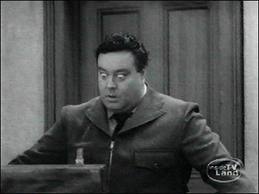
Jackie Gleason does his Chris Christie impression

… Imitation is the sincerest form of flattery, so I’ll take it that way.

— New Jersey Gov. Chris Christie reacting to President Barack Obama’s use of the phrase “big things”

Who’s more contemptible, Christie or Obama? The former is a bully, but the latter is the sort of eager conciliator who gives the whole pizza to the bully before the bully even asks for a slice. (No fat jokes, I promise.)

Read Obama’s recent pronouncements about fiscal policy. He agrees with Christie, in that part of his plan to get the economy back on track is to make like Herbert Hoover and cut services to the poor and middle class.

Obama and Christie are so alike, they’ve used variations on the same political slogan — “We do big things.” Christie has accused Obama of stealing this vacuous slogan and therefore must think it’s clever.

Obama did indeed say, “We do big things” in his Jan. 27 State of the Union address. The slogan was supposed to inspire, but it’s merely a reminder of his failure to do basic things, such as creating jobs programs for the long-term unemployed. He doesn’t promise a New Deal, a Fair Deal, or a Square Deal. He sees no New Frontier looming, and his idea of a Great Society, if his budget plan is an indication, is one percent of the population controlling the country’s wealth and offshoring American jobs.

Christie reacted to Obama’s speech by claiming he, the loud-mouthed governor, was the first guy to promise big things, back on Jan. 11. Not surprisingly, the big things on Christie’s agenda — cuts in pension and health benefit costs, and so-called educational reform — do nothing but reflect his small-mindedness. He’s in the forefront of the Republican movement to break unions and all other opponents of government run by the obscenely wealthy.

Read about Christie accepting the Lincoln Award at the Union League in Philadelphia (as if today’s Republicans have anything in common with Abraham Lincoln). Remember the video of him bullying a schoolteacher who asked him why he’s against tax cuts for the wealthy but thinks it’s OK to squeeze everyone else.

And realize this is what it’s come down to — a choice between Obama, a Democrat in name only, and Christie, an unfunny version of Jackie Gleason as Ralph Kramden on The Honeymooners. A lot of sound and fury signifying nothing but absolute loyalty to his wealthy backers.

Will voters catch on? I guess we’ll find out if and when a third party emerges before the 2012 elections.

Posted in Great Recession, mainstream media, NJ, Obama, Philadelphia, Politics, taxes, unemployment | Tagged , , , , , , , , , , , | 5 Comments

Sweet nothings? No thanks, I’m full


“All I have to do is remember and imagine the rustle of your skirt and I’m ready to chew my own hands off.” — Aleksei to Polina in Fyodor Dostoevsky’s The Gambler

Exactly. What a relief from the Valentine’s Day story on my service provider’s homepage: “They fell in love at the Home Depot.” And from Dr. Ruth, “There’s one thing you must say today…” And from the sea of crimson greeting cards and candy boxes at CVS, and the supermarket on South Street where you can’t buy canned soup without tripping over Mylar love balloons.

Dostoevsky is an antidote to ad slogans, to coma-inducing American culture, to the idea that romantic love is sane and pleasant and not funny. Alexsei again, but in the style of Groucho Marx: “Oh well, I’ll put off killing myself as long as possible, so that I can feel the insufferable pain of being without you.”

It’s a question of taste. If you like white bread with sugar on top, this is your day.

Posted in fiction, mainstream media | Tagged , , , , , , , , | 3 Comments

Beware the curse of Mubarak’s tomb


I'm still here!

Sir Joseph Whemple: [translating inscription] “Death [and] eternal punishment for anyone who opens this casket. In the name of Amon-Ra, the king of the gods.” Good heavens, what a terrible curse!
Ralph Norton: [eagerly] Well, let’s see what’s inside!

— from the screenplay of The Mummy, 1932

Hosni Mubarak has resigned — abdicated is more like it — and he’s as good as dead, right? In body, maybe, but his spirit will live on after the euphoria of the people he tormented for 30 years has faded.

Which is not to say our Arab friends uncorked their champagne substitutes too early, or that they shouldn’t be commended for bum-rushing the pharoah. There may yet be a bloodbath, but one can’t help being impressed when relatively peaceful protesters prevail, or at least appear to prevail, over the guys who hold the guns.

Inevitable comparisons between Egypt 2011 and Germany 1989 are being made. I was working in a newsroom in `89, when the East Germans were hacking away at the Berlin Wall. Everyone knew the world was changing, but was it changing for the good? Yes and no. Tyrants were overthrown, rights were reclaimed, but the dog-eat-dog version of capitalism that replaced Soviet-style communism did little to relieve poverty and injustice in Russia and many of its former satellite states.

It’s telling that no one in Washington, D.C., seemed to know what was happening in Egypt, even as it happened. Barack Obama’s instinct in critical moments — to respond with caution bordering on timidity — served him well. Republican uglies (imagine any of them siding with “the people” against the ruling class!) also got lucky, because they were too surprised by the revolution to put a convincingly negative spin on it.

We should enjoy Egypt’s great moment while it lasts and ignore American politicians who applaud the possible advent of democracy in the Arab world. Most of them are cheering unregulated capitalism, not democracy. If the latter was important to them, they’d take on the robber barons who are destroying what’s left of democracy in America. (See Bob Herbert for more on this.)

The Mubaraks of the world never quite go away because people everywhere, when desperate, tend to wonder if resurrecting an all-powerful ruler would set things right. (Let’s see what’s inside!) During the Great Depression, Germany saw in Hitler a new Frederick the Great. Italy mistook Mussolini for a Caesar. America opted for FDR, but only because most of the country maintained some faith in the democratic process. No one, not even Amon-Ra, can say for sure that Americans will keep the faith this time around.

Posted in Egypt, Great Depression, mainstream media, Obama, Politics | Tagged , , , , , , , , | Leave a comment

HuffPo/AOL — a new reason to avoid J-school


The next generation of American journalists

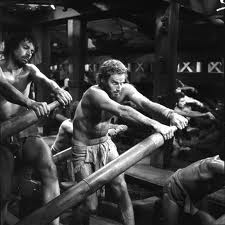
The Huffington Post is a brilliantly packaged product with a particular flair for addressing the cultural and entertainment tastes of its overwhelmingly liberal audience. To grasp its business model, though, you need to picture a galley rowed by slaves and commanded by pirates.

Tim Rutten, Los Angeles Times, Feb. 9

Arianna, say it ain’t so!

I don’t mean the sale of Huffington Post, we already know that would happen. And we knew you ran your ship with a low overhead, that many good writers have contributed to HuffPo merely for the sake of advancing causes they feel strongly about. (That and four dollars will get you a cup of coffee at Starbucks.)

I mean reports that you have used your shrewdness and Zsa Zsa charm to make a multimillion-dollar profit on the sale of HuffPo to AOL, a corporate dinosaur whose chairman, Tim Armstrong, wouldn’t give two stuffed grape leaves for the social consciousness you acquired in the 1990s while transitioning from a Newt Gingrich admirer to a California liberal.

What happens to the slightly left-of-center HuffPo now that it has become part of AOL’s lame effort to again become a serious media player? Is it true you recently downplayed HuffPo’s liberal identity and reminded readers that “politics” is just one of 15 sections in your infotainment vehicle? Are you gearing up for another wardrobe change?

You told Charlie Rose, “AOL has an incredible investment in video—and we intend to double down on that—a great investment in local [coverage] just in time for the Presidential election, over 800 towns already being covered by professional journalists.”

This is marvelous, but you didn’t mention that most AOL reporters are paid next to nothing, and that online news venues are feeding off what’s left of print journalism — relying on it for “content,” that is — as they help kill it. And that the end of print journalism will make mainstream news even less informative than it already is.

What happens, Arianna, to those reporters, in Philadelphia and around the country, when newspapers like the Inquirer and Daily News die? Will you fight for their right to make a decent wage at online venues, maybe even use some of your vast fortune to see that this happens?

As the Duke would say, “That’ll be the day.” More likely, you’ll continue to stroll the main deck, smiling for the cameras, as the slaves in the galley below power you to your next acquisition.

Posted in mainstream media, Philadelphia, Politics | Tagged , , , , , , , , | 1 Comment

Fergie and Fyodor do the Super Bowl


Fergie

Yes, we shall set them to work, but in their leisure hours we shall make their life like a child’s game, with children’s songs and innocent dance. — from the Grand Inquisitor’s speech in Fyodor Dostoevsky’s The Brothers Karamazov

And we shall render unto them Fergie, and they shall love us, for Fergie has sturdy legs and strong lungs and shall deliver unto them a full-force gale, off-key and off-kilter, so that halftime shall be even more awesome than the game, which shall be won by the gladiators from the ancient steel town, or the gladiators from the hamlet in suburban Siberia.

And we shall call the children “fans” and deliver unto them the gift of forgetfulness, and reduce their attention span to the length of a pop song, and to the knowledge that each fourth down shall be followed by a plague of shills, each of whom shall surrender to us vast sums for precious seconds of airtime.

And we shall strike into these shills the fear that fans shall changeth the channel if the camera doth linger for more than a blink on any one of them, or on the lame medley of pop tunes, or on the gladiators.

And we shall make of America a theme park where fans shall labor on cube farms and in food shacks, and we shall reward them with diversions that not so long ago were the province of preschoolers.

And we shall declareth new champs, and they shall speaketh like the old champs, and the fans shall pass to laughter and rejoicing, and within days shall move on to spring training.

Posted in mainstream media, pop music, sports | Tagged , , , , , , , | 5 Comments

Live from Egypt… the illusion of information


What can a poor boy do?

I’ll shout and scream, I’ll kill the king, I’ll rail at all his servants.Street Fighting Man,” Rolling Stones, 1968

Rocks are being thrown on the CBS newscast. At MSNBC, Rachel Maddow is telling me what a Molotov cocktail is. Her backdrop is a video loop of someone throwing a Molotov at a crowd on a bridge in Cairo. The bottle of gasoline lands and ignites, scrawling rings of fire in the night as it rolls along the bridge. The sequence, playing over and over, is beautiful and ultimately sleep-inducing, which is OK, because it’s late and there’s really no news.

In fact, the closer the news crews get to the Egyptian street fights, the less we learn about the big picture. Anderson Cooper of CNN is so close, he gets punched in the head for his trouble. We learn that Cooper is a gutsy fellow, but we still don’t know why the army let pro-Mubarak goons into Tahrir Square. We don’t know what, if anything, Barack Obama is doing to compel Mubarak to step down, or whether it would be a good idea for protest leaders to meet with Mubarak’s henchmen. We don’t know for sure who the real leaders are. Who will step forward to speak, and will the spokespersons represent the wishes of the protesters?

This is the fun part of the fight, before the guys with the guns step in. It feels good to lose yourself in the crowd, to become the crowd, especially when you aspire to something noble. What can a poor boy do, `cept to sing rock ‘n’ roll or throw rocks? (My fondest childhood memories of Southwest Philly.) What could be more heartening than the thunderous rumble of you and your homeys beating lengths of pipe against plastic shields, the sound of solidarity, striking fear in your enemies?

The hypocrites in Washington, D.C., are mostly silent. Eventually, the protesters and the rest of the world will find out whether Egypt has got past first base in its bid to rid itself of oppressive rulers. Meanwhile, let’s not kid ourselves that what we’re watching on TV and the Internet is anything more than infotainment, or that talking heads are in the know, or that tweeting and Facebooking amount to anything more than vicarious involvement in events we don’t yet understand.

We rarely hear news of who’s really running the show in America, despite 24/7 coverage by the media. Why should we assume we’re learning anything about who will run Egypt?

Footnote: “It’s quite possible that if Mubarak had not ruled Egypt as a dictator for the last 30 years, the World Trade Center would still be standing…” from Ross Douthat, of all people.

Posted in mainstream media, Obama, Politics | Tagged , , , , , , , , , | Leave a comment

Egypt, Iraq and neocon doubletalk


Our friend, the dictator

The post-2003 democratic wave was brief and somewhat shallow, and it indirectly benefited Hamas and Hezbollah as well as the Kurds and Shiites of Iraq and the Lebanese democracy movement. But the regime-change school in America can claim a degree of vindication. — Christopher Hitchens, Jan. 31, Slate

There’s a lot of auguring going on now that we’ve entered the age of Peak Oil and climate change and new political upheaval in the Middle East. Is it food shortages that trigger revolutions? Too much brutality by the regime? The shutting down of Internet access and the subsequent trauma of life without Facebook?

Hitchens would have us believe the tipping point for revolution is a mass feeling of “indignity and shame” that results when dictatorships too blatantly remind the people that they’re being exploited — i.e., when the dictator builds too many palaces for himself or stops bothering to pretend elections are fair. “People do not like to be treated like fools,” Hitchens writes, referring in this case to the treatment of Egyptians by Hosni Mubarak and his goons.

But wait — tens of millions of Americans were made fools of by the U.S. government, which bailed out the Wall Street con men who helped trigger our ongoing economic crisis and did nothing to curtail record unemployment or stop mortgage foreclosures. If the tipping point was the degree to which people feel they’ve been had, then Lloyd Blankfein and his fellow robbers would be swinging by their necks from the lampposts in Lower Manhattan.

Hitchens’ subtext is his desire for “vindication.” He and his fellow neocons are still arguing the U.S. did the right thing when it invaded Iraq and deposed Saddam Hussein in 2003, even though the invasion resulted in the deaths of tens of thousands of innocent people and political instability that persists to this day. At the same time, he’s saying it would not be the right thing for the U.S. to help depose Mubarak, a dictator almost as brutal as Saddam, because the Egyptian people, after deciding they’ve been made fools of, should do this on their own.

So which is it — do we depose all dictators or only those who aren’t our friends? Does the “regime-change school” only want democracy for countries that don’t support anti-U.S. groups such as Hezbollah?

Hitchens was a neocon, but now he’s arguing for realpolitik. If only he’d stop pretending he’s making a case for morality.

Posted in economic collapse, finance reform bill, Goldman Sachs, Great Recession, mainstream media, Politics, Wall Street, world-wide economy | Tagged , , , , , , , | 1 Comment

U.S. foreign policy running on empty


The State Department didn't see this coming?

The rise of powerful Islamic parties [in Egypt] appears inevitable… not because of the Quran or a backward tradition, but because we and Israel believed we could bend the aspirations of the Arab world to our will through corruption and force. — Chris Hedges, Jan. 31, Truthdig

U.S. foreign policy is like the mattress delivery truck I saw the other day in South Philly. The driver and his co-pilot made the mistake of braving a narrow street to make a delivery a day after a snowstorm. The street had been plowed but not thoroughly, and the truck was soon spinning its wheels, stuck in snow that was deeper than it looked. Three times the truck got stuck and broke free after a lot of wasteful revving and gear-grinding and spewing of exhaust fumes. But then the driver was too impatient to make the tricky turn onto Ninth Street and instead forged onto the next little street, where the truck got stuck in the same mess.

The drivers at the U.S. State Department hold the wheel steady and forge into one Third World country after another, confident that America has the horsepower and sheer bulk to roll over any obstacles to our acquisition of cheap oil. Are the people pissed off because the Shah or Saddam Hussein or Hosni Mubarak is torturing/starving/stealing from them? No problem, send the dictator another billion to bulk up the army, and gently advise him to stop slaughtering so many activists and give the people a bit more grain.

This is called realpolitik, the religion of characters like Henry Kissinger and Hillary Clinton — high-profile policy wonks who are always surprised when, after decades of repression, these Third World side streets, our shortcuts to the oil fields, are suddenly jammed with millions of people angry not only at the dictators but at those who propped up the dictators in order to fuel America’s gas guzzlers.

We lost Iran because we backed the Iranians who were on the wrong side of history. The same thing might be happening in Egypt, regardless of how and when Mubarak makes his exit. Once again, the big truck is spinning its wheels, but this time it’s a lot closer to running out of gas.

Posted in mainstream media, Obama, Politics, world-wide economy | Tagged , , , , , , , , , , | Leave a comment

Working at the Inky/DN will be a hard habit to break


Julio Cortazar understood the allure of habits, good and bad.

Tighten your fingers around a teaspoon, feel its metal pulse, its mistrustful warning. How it hurts to refuse a spoon, to say no to a door, to deny everything that habit has licked to a suitable smoothness. — Julio Cortazar, Cronopios and Famos

I was running to reach the post office before closing time. I hurtled a mound of snow to get around a slow-walking elderly gent on a narrow pathway in South Philly. The old gent, all in black and hooded, looked like Woody Allen spoofing the Grim Reaper in The Seventh Seal. He chuckled when I landed and continued running — heh-heh-heh — as if to ask “What’s your hurry?”

Good question. I’m not much younger the old gent, and will catch up with him soon enough on the road to oblivion. In fact, I run not so much to beat deadlines as out of habit, because it’s the mode of transport that best suits me. I run, or bike when I can, because these habits make me feel less anxious than driving, which I avoid as much as possible.

I thought of the comfort of habits when I read Steve Volk’s thoughtful piece in Philadelphia magazine about Greg Osberg, the new CEO of Philly’s two daily newspapers. Osberg seems smart and amiable, not at all like one of those managers who tries to make up for lack of talent by lopping off heads or other body parts. (A former managing editor at the Inquirer said saving the papers will necessitate desperate measures, “something equivalent to cutting off a limb.”)

Osberg has good ideas and might do a better job of trying to salvage the papers and Philly.com than his predecessor, the pudgy propagandist Brian Tierney. But he’s still a CEO whose main responsibility is to promote the bottom-line interests of corporate owners, and that means more heads will roll as the bean counters continue to press for a revenue source to replace the advertisers who are jumping ship as sales of the papers’ print editions plummet.

More and more writers and editors will have to do without those smoothly worn habits — the drive to the office, the mug and spoon and coffee, the gossip with fellow cube rats — and without paychecks, as we move further into the brave new world of online publications, which often make do with skeleton crews. Lurking behind the questions posed by Volk’s article is a bigger question — what will happen to all the people made redundant, as the British say, by workplace innovations and changing reading habits?

No one knows the answer, except maybe the man in the black hood.

Posted in economic collapse, globalization, mainstream media, Philadelphia, unemployment, world-wide economy | Tagged , , , , , , , , , , , | Leave a comment

The ‘decoupling’ of Americans from good jobs


… The President’s failure to address the decoupling of American corporate profits from American jobs, and explain specifically what he’ll do to get jobs back, not only risks making his grand plans for reviving the nation’s “competitiveness” seem somewhat beside the point but also cedes to Republicans the dominant narrative. — Robert Reich, Jan. 26

Thank you, Robert Reich, for acknowledging “the elephant in the room” ignored by the mainstream journalists who, in yesterday’s news, further buffed and polished Obama’s brilliantly banal speech. And congrats on “decoupling,” which politely describes a horrendous phenomenon hardly ever cited, or even sighted, when editorial sages explore the widening gulf between rich and poor Americans.

(On an upbeat note, at least the money wasters in Philly government have yet to decouple snow plow operators from their jobs.)

I know I’ve asked you this before, Bob, but isn’t it time you stopped pretending Obama is any better than the people with whom he’s chosen to surround himself, including Jeffrey Immelt, CEO at General Electric, which “has more foreign employees than American,” as you so pointedly noted? Could you maybe start writing about elected Democrats with a social conscience and fighting spirit who might want to challenge Obama when he runs for re-election? (As if he’s not running already.)

Enough. I’m going outside now to throw snowballs. It’s more therapeutic than wasting words on Obama.

Posted in globalization, Great Recession, mainstream media, Obama, Philadelphia, Politics, unemployment | Tagged , , , , , , | Leave a comment