Veterans Day Beefheart


I cry but I can’t buy
Your Veteran’s Day poppy
It don’t get me high
It can only make me cry
It can never grow another
Son like the one who warmed me my days
After rain and warmed my breast
My life’s blood

From Wikipedia:

The red remembrance poppy has become a familiar emblem of [Veterans] Day due to the poem “In Flanders Fields”. These poppies bloomed across some of the worst battlefields of Flanders in World War I, their brilliant red colour an appropriate symbol for the blood spilled in the war.

From Lester Bangs’ 1969 review of Trout Mask Replica, the album on which “Veterans Day Poppy” appeared:

… While many other groups have picked up on the trappings of the new jazz, [Captain Beefheart] and the Magic Band are into its essence, the white-hot stream of un-“cultured” energy, getting there with a minimum of strain to boot. This is the key to their whole instrumental approach, from the drummer’s whirling poly- and even a-rhythmic patterns (compare them to Sonny Murray’s on Ayler’s Spiritual Unity or Ed Blackwell’s on Don Cherry’s Symphony for Improvisers), to the explosive, diffuse guitar lines, which (like Lou Reed’s for the Velvet Underground or Gary Peacock’s bass playing on Spiritual Unity) stretch, tear, and distend the electric guitar’s usual vocabulary with the aim of extending that vocabulary past its present strictly patterned limitations…

Posted in arts, Politics, pop music | Tagged , | 1 Comment

Debunking Mitt’s most recent big lie


Here’s how the corporate media works: The well known double-talker Mitt Romney makes dubious statements meant to undermine another candidate. Reporters write stories that leave Mitt’s statements unchallenged. Readers are left with the impression that Mitt is stating facts.

It is often days before the dubious statements are challenged in the publication that ran them, usually in a “he said/she said” analysis piece or a blandly worded editorial that impresses no one.

Then, finally, the dubious statements — lies, that is — are totally refuted by a columnist. But it’s implicit that the columnist is only stating opinions, even when he or she is obviously debunking bald-faced lies.

Here’s Paul Krugman, The New York Times’ designated debunker, responding to lies by Mitt Romney that should have been corrected by reporters and editors:

…Mitt Romney has accused President Obama of taking his inspiration from European “socialist democrats” and asserted that “Europe isn’t working in Europe.” The idea, presumably, is that the crisis countries are in trouble because they’re groaning under the burden of high government spending. But the facts say otherwise.

It’s true that all European countries have more generous social benefits — including universal health care — and higher government spending than America does. But the nations now in crisis don’t have bigger welfare states than the nations doing well — if anything, the correlation runs the other way. Sweden, with its famously high benefits, is a star performer, one of the few countries whose G.D.P. is now higher than it was before the crisis. Meanwhile, before the crisis, “social expenditure” — spending on welfare-state programs — was lower, as a percentage of national income, in all of the nations now in trouble than in Germany, let alone Sweden.

It’s a hell of a way to run a news operation, isn’t it?

Posted in economic collapse, Great Recession, liar, mainstream media, Mitt Romney, New York Times, Politics, The New Depression, unemployment | Tagged , , , , | Leave a comment

Federal judge to SEC: Do your job!


Maybe the SEC hasn’t done a better job of policing Wall Street and protecting investors from fraud because the SEC itself is a fraud:

A federal judge Wednesday challenged the SEC’s plan to settle a fraud case against Citigroup for $285 million, saying that the deal would recoup only a fraction of investors’ losses and would leave the firm free to proclaim its innocence in private lawsuits over the remaining damages.

The judge used the Citigroup case to mock the SEC’s traditional way of doing business — allowing defendants to settle without admitting or denying wrongdoing.

The unproven allegations, U.S. District Court Judge Jed S. Rakoff said, “are no better than rumor or gossip.”

“Does not the SEC of all agencies have an interest in establishing what the truth is?” Rakoff asked.

It was the third case since the financial meltdown of 2008 in which Rakoff sharply questioned the value of enforcement actions brought by the Securities and Exchange Commission, which is responsible for policing Wall Street and protecting investors.

Citigroup is accused of misleading investors about a 2007 transaction tied to the deteriorating housing market in which the firm bet against its customers and made profits of $160 million while the customers lost more than $700 million.

Matt Taibbi took a look at the numbers and came up with a fitting analogy:

Rakoff of course is right – the settlement is nuts. If you take Citi’s $160 million profit on the deal into consideration, what we’re talking about then is a $125 million fine for causing $700 million in damages. That, and no admission of wrongdoing.

Just imagine a mugger who steals $70 from some lady’s wallet being sentenced to walk free after paying back twelve bucks. Magritte himself could not devise a more surreal take on criminal justice.

Posted in economic collapse, Great Recession, Obama, The New Depression, Wall Street | Tagged , , , , | 1 Comment

Thanks for the memory, Rick


I hope this tough-talking, carefully coiffed hombre keeps better track of his guns and ammo than he does of his talking points during debates:

Republican presidential candidate Rick Perry says he will eliminate three federal agencies if elected president, but he just isn’t sure what they are. At Wednesday night’s CNBC Republican presidential debate, the candidate managed to remember the first two agencies but repeatedly failed to name the third.

Posted in enviromentalism, humor, mainstream media, Politics | Tagged , , | 1 Comment

A sick joke from Romney, ‘the serious one’


David Brooks, the Earnest Weasel, recently cited Mitt Romney’s plan to semi-privatize Social Security and Medicare and link these programs to Wall Street as proof that Romney is “the serious one” among Republican presidential candidates. Here’s Matt Taibbi on the audacity of these buttoned-down bozos:

Your typical Medicare/Social Security recipient might already have been ripped off three different ways in this era.

He might have been sold a crappy mortgage or a refi by a Countrywide-type firm (which often targeted the elderly). He might then also have unwittingly become an investor in such mortgages and seen the value of his retirement holdings devastated (many of the banks sold their crappy mortgage-backed securities to state pension funds). Lastly, if he paid taxes, he saw part of his tax money go to pay off the bets the banks made against these same mortgages.

So now that Wall Street has ripped off this segment of society three times, it makes all the sense in the world that Mitt Romney – a former Wall Street superstar who was a chief architect of the modern executive-compensation-driven corporation – is coming back and telling us that we need to cut their Medicare and Social Security benefits in order to defray the cost of the previous three scams…

If there wasn’t such a very real chance that this could happen, it would be worth laughing about, but unfortunately it’s no joke. It’s a testament to the tenacious idiocy of our national media that an idea like Social Security privatization could continue to be publicly contemplated, in the wake of a disaster on the scale we’ve just gone through.

Advocating the turning over of Social Security management to Wall Street after the 2008 crash is a little like asking Paris Hilton to pilot Air Force One, or tabbing Charlie Sheen to manage the inventory of a hospital pharmacy – completely nuts, but to David Brooks, that makes Mitt Romney the “serious” candidate.

Posted in David Brooks, economic collapse, Great Recession, liar, mainstream media, Mitt Romney, New York Times, Politics, Wall Street, weasel | Tagged , , , , | 1 Comment

Frazier dies. Fight of the century continues.


You had to be there, I guess, to appreciate the significance of the first Muhammad Ali-Joe Frazier fight, on March 8, 1971. Not necessarily at ringside, but aware of the mood of the country. It was as if a civil war was being vicariously fought in Madison Square Garden, with each side represented by its champion.

In Ali’s corner were opponents of the Vietnam War, blacks fed up with second-class-citizen status, a large contingent of intellectuals and artists and college kids, affluent liberal types, and people who simply thought Ali was the coolest man on the planet.

Frazier appealed to the World War II generation of working-class whites and blacks who didn’t like Ali’s flamboyant outspokenness. Frazier was the real Rocky, a guy who became a great fighter through sheer force of will. He was also a strong black man who didn’t seem threatening to whites who already felt threatened by “uppity” blacks.

The backdrop, in a nutshell: I was a kid growing up in white working-class Philly and can’t remember a single adult in that little world ever calling Ali by any other name than Cassius Clay, even though he’d changed his name years earlier and everyone knew it.

The bout lived up to its billing as “the fight of the century.” The whole world watched two of the best heavyweights in boxing history slug it out for 15 rounds. Frazier won the decision because he flattened Ali with a vicious left hook in the last round.

Ali and Frazier half-killed each other — there were two more fights, both won by Ali — and their war of words, begun before the first fight and fueled partly by the social strife that defined the era in which they fought, persisted after they retired. Ali outlived Frazier but has suffered from Parkinson’s disease for a long time.

Stan Hochman, a long-time sportswriter for Philadelphia Daily News, neatly summed up their epic story the day after Frazier died:

They brought out the best in each other in the ring and the worst in each other outside the ring. And now Frazier is gone and Ali cannot put two sentences together to mourn our loss. And that is terribly sad.

It’s also sad that the societal divisions that helped make the Ali-Frazier rivalry so bitter and symbolically weighty have grown drastically worse in the 40 years since their first fight. The discontent of the poor and near-poor, dormant for decades, has been rekindled by the widespread realization that the rich have slyly encouraged these divisions — between poor and middle-class, black and white — in order to distract us from the fact that they’re robbing us all. (I’ve just described the genesis of the Occupy Wall Street movement.)

I don’t know if Frazier would see it that way, but one thing’s for sure — he didn’t tolerate anyone making a fool of him, in or out of the ring, and he never backed down from a fight.

Posted in Great Recession, mainstream media, Philadelphia, Politics, sports, The New Depression, unemployment | Tagged , , , , , | 2 Comments

More news pollution from the NYT


In a Sunday op-ed piece, Frank Bruni complained that Americans get worked up to no good end — headline: “The invention of outrage” — over what passes for news these days. Well, no shit. The odd thing about the piece was that Bruni didn’t bother to explain the difference between gossip and real news:

If ever you needed an example of how easily, spuriously or conveniently we gin up our outrage, last week was it. As we kept up with [Kim] Kardashian, kept tabs on a constipated Congress and beheld both the turmoil in Greece and the travails of Herman Cain, we summoned astonishment where there was questionable grounds for it and an ire sometimes out of proportion with the circumstances. So did the players in a few of these dramas and the parasites feeding off them. It was a mad, mad week.

My first thought was yo, Frank, if you want to hear less about bimbos such as Kardashian, don’t devote half of an article to her. Don’t mention her at all. My second thought was don’t equate coverage of vapid “personalities” with stories about our dysfunctional Congress, which is still hung up on reducing debt rather than creating jobs.

Bruni and many of his colleagues are like factory workers who dump toxins into a river and then complain about all the dead fish. What is this guy smoking?

Was he complaining about the general public’s tendency to become outraged over “news” that’s actually trivia, or the media’s purposeful reduction of all news to trivia? It’s not quite clear.

What Bruni should have written about is the remarkable absence of outrage in America over issues that directly effect our health and well-being. For decades most Americans were bamboozled into believing the increasingly wide income gap between the rich and poor was nothing more than a healthy result of the free market system at work.

The corporate media does everything it can to encourage belief in this lie. One of its tricks is to distract us from important issues by prominently running stories about bimbos and sideshow freaks while at the same time under-reporting the ways in which the rich and powerful have institutionalized inequality in our sick society.

My suggestion for Bruni, if he wants to write something substantive, would be to stop following the Kardashian news, ride the subway to Zuccotti Park and ask some of the protesters why they are there. It really is an outrage.

Posted in Congress, economic collapse, environmentalism, Great Recession, mainstream media, New York Times, Occupy Wall Street, Politics, The New Depression, unemployment, Wall Street | Tagged , , , , | Leave a comment

Who crashed the economy? NYT dodges question.


Thanks for nothing, New York Times. I refer to the analysis piece in the Sunday edition, above the fold on Page 1, that totally obscures the causes of the economic mess that is destroying the middle class and making the poor even poorer. Yet another example of how absurd it is to accuse The Times and other corporate-owned news operations of being part of the liberal media.

The writer, David Leonhardt, states early on that America’s economic problems begin and end with debt, which he links to our aging population and slow economic growth. Astonishingly, he neglects to mention that the huge size of the debt is directly attributable to George W. Bush’s tax cuts for the rich and his decision to launch two unfunded, enormously expensive wars on the other side of the world.

Instead, Leonhardt seems to blame the so-called debt crisis on the apathy and unrealistic expectations of the general public:

Most voters in [the United States and Europe] have yet to come to grips with the notion that they have promised themselves benefits that, at current tax rates, they cannot afford. Their economies have been growing too slowly, for too long, to pay for the coming bulge of retirees…

On the most basic level, affluent countries are facing sharply increasing claims on their resources even as those resources are growing less quickly than they once were…

The increasing claims come from the aging of the population, while the slowing growth of available resources comes from a slowdown of economic expansion over the last generation. A complex mix of factors, varying by country, has slowed growth, and the slowdown has been exacerbated everywhere by the worst financial crisis and global recession in 70 years.

Yes, but who and what caused the slowed growth of resources and the financial crisis that exacerbated the slowdown? Leonhardt dances around this essential question, perhaps because he and his editors would rather not flatly state that one percent of the population — including the owners of The Times — have thrived at the expense of the other 99 percent, largely because of laws passed by high-level political officeholders whose interests are aligned with the one percent, not with the rest of us.

Some readers would call Leonhardt’s handling of the debt issue intellectually dishonest, but that doesn’t quite say it. The man writes as if he’s a willing stooge for the people who are steadily and intentionally lowering the living standards of average Americans. More than once he stresses the “hard choices” we face, but not until the story’s 12th paragraph does he casually mention that there is “debate” in this country about “whether the affluent, who have done very well in recent decades, should pay more taxes.”

The debate is over. Most Americans have caught on to why the economic situation is so bleak. We’re strongly in favor of higher taxes on the rich and many other common-sense measures that Leonhardt’s article either doesn’t mention or carefully downplays.

Posted in Congress, economic collapse, Great Recession, mainstream media, New York Times, Politics, taxes, The New Depression, unemployment | Tagged , , , | 3 Comments

Great lit to great film? Well, there’s ‘The Dead’


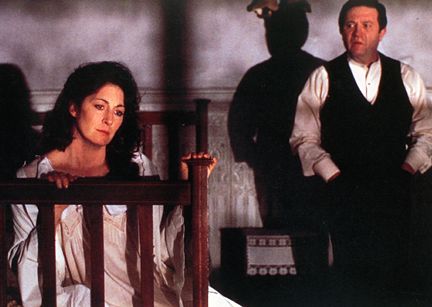
Anjelica Huston and Donal McCann in ‘The Dead’

How often have great literary works been made into great movies? Certainly more often than the Eagles have won the Super Bowl (never), but only slightly more often than the Phillies have won the National League championship (seven times).

What’s beautiful and fascinating on the page is usually lost in translation to the screen. One exception is the 1987 film of James Joyce’s short story “The Dead,” by director John Huston and screenwriter Tony Huston (John’s son), which was recently mini-reviewed in the NYT by Rodrigo Garcia, film director and son of novelist Gabriel García Márquez:

… It’s the tale of a dinner party and its aftermath on the Feast of the Epiphany in the home of the Morkan sisters on a snowy winter evening in Dublin in 1904… It’s devoid of much plot and deceivingly simple. The themes are ambitious: self-delusion, vanity, mortality, the effect of the passage of time on our feelings. All of it is told with humor and with affection for little human strengths and weaknesses, and with the tenderness and delicacy of a girl playing with a dollhouse…

… [John Huston] is responsible for “The Maltese Falcon,” “The Treasure of the Sierra Madre” and “The African Queen…” He made some of his best and youngest films the older he got, until finally, at 80, armed with a wheelchair and an oxygen tank and two of his children (Anjelica and Tony), he made the perfect film, “The Dead.” Now that, ladies and gentlemen, was a director.

Near the end of the short story, the protagonist’s wife tells him about a young man named Michael who had loved her long ago but died. He realizes he has never deeply loved anyone, including his wife. The last lines of the story, which is told from the protagonist’s point of view:

A few light taps upon the pane made him turn to the window. It had begun to snow again. He watched sleepily the flakes, silver and dark, falling obliquely against the lamplight. The time had come for him to set out on his journey westward. Yes, the newspapers were right: snow was general all over Ireland. It was falling on every part of the dark central plain, on the treeless hills, falling softly upon the Bog of Allen and, farther westward, softly falling into the dark mutinous Shannon waves. It was falling, too, upon every part of the lonely churchyard on the hill where Michael Furey lay buried. It lay thickly drifted on the crooked crosses and headstones, on the spears of the little gate, on the barren thorns. His soul swooned slowly as he heard the snow falling faintly through the universe and faintly falling, like the descent of their last end, upon all the living and the dead.

John and Tony Huston make slight alterations to Joyce’s text so that the voice-over is in first-person and conveys to viewers the shock of self-awareness felt by the protagonist, played with great reserve by Donal McCann.

Footnote: If your idea of a great film is Transformers, this movie might not be for you.

Posted in arts, fiction, movies | Tagged , , , , | 5 Comments

Hedges arrested. King Rat still rules.


In case you missed it, Chris Hedges took a moment to cogently connect the dots between the big investment banks and the Obama administration on Thursday, before he marched with several hundred other protesters to the mouth of the sewer — the corporate headquarters of Goldman Sachs:

Goldman Sachs is able to carry out its malfeasance at home and in global markets because it has former officials filtered throughout the government and lavishly funds compliant politicians—including Barack Obama, who received $1 million from employees at Goldman Sachs in 2008 when he ran for president. These politicians, in return, permit Goldman Sachs to ignore security laws that under a functioning judiciary system would see the firm indicted for felony fraud. Or, as in the case of Bill Clinton, these politicians pass laws such as the 2000 Commodity Futures Modernization Act that effectively removed all oversight and outside control over the speculation in commodities, one of the major reasons food prices have soared…

Goldman Sachs unloaded billions in worthless securities to its clients, decimating 401(k)s, pension and mutual funds. The firm misled investors about the true nature of these worthless securities, insisted the securities they were pushing on their clients were sound, and hid the material fact that, simultaneously, they were betting against these same securities—$2 billion against just one of their deals…

CEO Lloyd Blankfein apparently not only lied to clients, but to the [Senate subcommittee investigating Goldman-Sachs] on April 27, 2010, when he told lawmakers: “We didn’t have a massive short against the housing market, and we certainly did not bet against our clients.” Yet, they did.

Hedges was arrested with 15 other protesters, including longtime NYC activist The Reverend Billy. Meanwhile, Blankfein and his fellow rats remain free and presumably busy in their gilded sewer, where they sold bundles of bad mortgages — bundles of shit — and called them securities, as part of a grand scam to fleece their clients.

Posted in Congress, economic collapse, Goldman Sachs, Great Recession, liar, Occupy Wall Street, Politics, The New Depression, unemployment, Wall Street | Tagged , , , | 1 Comment