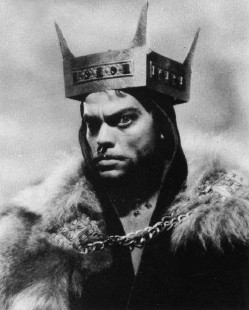
Sound and fury, signifying status quo


Macbeth contemplates murder after hearing the phrase 'debt ceiling"

Joseph Stiglitz, a few months ago in Vanity Fair:

The more divided a society becomes in terms of wealth, the more reluctant the wealthy become to spend money on common needs. The rich don’t need to rely on government for parks or education or medical care or personal security — they can buy all these things for themselves. In the process, they become more distant from ordinary people, losing whatever empathy they may once have had.

Invoking Stiglitz, Dee Dee Myers recently made the point that a significant majority of Americans want higher taxes on the rich, and that Barack Obama must insist on these increases “to ensure that any deal he may be able to strike [on the debt ceiling] moves us back toward a society where the burdens are shared equally — by all our people.”

But Obama hasn’t insisted on anything. Instead, we’ve heard him offer to cut a deal with Republicans that would chip away at the programs that form the foundation for America’s social safety net. As a Dem official said yesterday, Obama “wants the largest deal possible – with tough spending cuts, including entitlement reforms, and savings from the tax code.”

Lost in speculation over whether Obama or the Republicans will be perceived as the winner of the debt ceiling fight is the fact that the rest of us lose, regardless. It needs to be repeated: Obama long ago showed his true nature by bailing out the banksters, going along with extension of the Bush-era bonus tax cuts, and taking pathetic half-measures to stimulate jobs growth.

The debt ceiling will be raised. Obama will prevail over the Tea Party freaks — Wall Street has told both major parties no default on the debt! — but ending the drama won’t change the parties’ indifference to the plight of the unemployed, homeless and bankrupt. We’ll see nothing like the FDR-era Works Progress Administration (WPA), Civilian Conservation Corps (CCC) National Youth Administration (NYA), or National Housing Act of 1934.

High-profile Dem politicians will continue to buy state-of-the-art citadels, maybe with drawbridges, often in the same neighborhoods as corporation owners, Wall Street banksters and elected Republicans. Many Americans who aren’t wealthy, D or R, will continue to slide into the ditch, usually without a peep, because there is no way to register dissatisfaction through our existing electoral system.

This will change someday, of course, but not in an orderly, civilized fashion, because the mechanisms of orderly change have been broken — i.e., almost all office holders and their challengers are beholden to wealthy backers — and it’s in the interest of the people who own and run both major parties to keep them broken.


Posted in Congress, economic collapse, Great Recession, mainstream media, Obama, Politics, unemployment, Wall Street, world-wide economy | Tagged , , , , , , , , | Leave a comment

Will Obama side with workers? Don’t hold your breath


I saw this from WP posted on Suburban Guerrilla and could hardly believe I was reading about a Democratic president:

SEATTLE — President Barack Obama is calling once again for Boeing Co. and its workers to resolve their differences without “wasting a lot of time in court.”

Obama was asked about the National Labor Relations Board’s lawsuit against the aerospace giant in a KING-TV interview aired Friday night. The president restated an earlier comment that “businesses should be able to locate wherever they want to operate” and have to follow the law.

But Obama noted America is “competing against folks around the world who are after our jobs and our businesses and our market share.” He added, “We can’t afford to have businesses and their workers arguing instead of coming together to try to produce the best possible products and sell them as aggressively as possible.”

The NLRB alleges that Boeing retaliated against its unionized work force in Washington state by opening a new production line for its 787 airplane in South Carolina, which is a right-to-work state. The case could drag on for years.

What does “work out their differences” mean? I’m picturing a heavyweight kicking the shit out of a dwarf and a cop standing by and saying, “That’s it, boys, work it out.”

Boeing is building a plant in a “right to work” (anti-union) state, and Obama, as he does with all controversies, is twiddling his thumbs rather than taking a stand. Does he think big business should have the right to force down workers’ salaries and effectively break unions, or doesn’t he? Remember when he promised to put on comfortable shoes and walk with union members? By what definition is he a Democrat?

At this rate, Obama might go down in history as The President Who Wasn’t There — the man who wore sharp suits but presided in a dull, passive way over the dismantling of the New Deal and what was left of organized labor.

Posted in economic collapse, globalization, Great Recession, mainstream media, Obama, Politics, unemployment, world-wide economy | Tagged , , , , | Leave a comment

‘Nice economy you had here…’


Here’s Paul Krugman last week in The New York Times, urging Barack Obama “to draw a line in the sand” regarding the debt ceiling issue:

So what’s really going on is extortion pure and simple. As Mike Konczal of the Roosevelt Institute puts it, the G.O.P. has, in effect, come around with baseball bats and declared, “Nice economy you have here. A real shame if something happened to it.”

And the reason Republicans are doing this is because they must believe that it will work: Mr. Obama caved in over tax cuts, and they expect him to cave again. They believe that they have the upper hand, because the public will blame the president for the economic crisis they’re threatening to create. In fact, it’s hard to avoid the suspicion that G.O.P. leaders actually want the economy to perform badly.

Republicans believe, in short, that they’ve got Mr. Obama’s number, that he may still live in the White House but that for practical purposes his presidency is already over. It’s time — indeed, long past time — for him to prove them wrong.

It’s good advice, but Krugman, like many other observers, is watching this Obama comedy play out with a sinking feeling that the president is about to fall off a cliff and take Social Security and Medicare with him rather than call the GOP’s bluff on its threat to vote against raising the debt ceiling.

Obama’s die-hard supporters think he’s backing up to ensure himself a second term, by painting intransigent Republicans as extremists. It’s Bill Clinton-style triangulation all over again, they say. Sounds good until you consider what this means to the rest of us. By messing with entitlements and not calling for substantially higher taxes on the rich, Obama only proves there’s not a dime’s worth of difference between the major parties.

In the old Warner Brothers cartoon, Bugs Bunny draws a line in the sand and dares Yosemite Sam to step over it. Sam does so and Bugs, backing up, draws another. He keeps drawing lines and backing up until he fools Sam into stepping off a cliff.

Except that in the modern-day cartoon of D.C. politics, it looks like Bugs (Obama) is the one who will take the fall. He’s not fooling anyone. If he caves on the cornerstone programs of America’s social safety net, especially in our rapidly worsening economy, there’s nowhere for him to go but down.

Posted in Congress, economic collapse, Great Recession, mainstream media, Obama, Politics, unemployment | Tagged , , , , , | Leave a comment

To Frank Rich, the future looks like Hamlet, Act V


Thy offense is rank, Wall Street. It smells to heaven.

You may have noticed that more and more social critics are looking at the future and seeing very few smiley faces. Here’s Frank Rich’s take on the end of the world as we know it:

What haunts the Obama administration is what still haunts the country: the stunning lack of accountability for the greed and misdeeds that brought America to its gravest financial crisis since the Great Depression. There has been no legal, moral, or financial reckoning for the most powerful wrongdoers. Nor have there been meaningful reforms that might prevent a repeat catastrophe. Time may heal most wounds, but not these. Chronic unemployment remains a constant, painful reminder of the havoc inflicted on the bust’s innocent victims. As the ghost of Hamlet’s father might have it, America will be stalked by its foul and unresolved crimes until they “are burnt and purged away.”

Nicely put, but I wonder if Rich is hip to the implications of the sentence I bolded or merely reminding us he used to be a drama critic. If the former is the case, then he’s saying that the likelihood of bringing to justice the Wall Street crooks who trashed the economy is slim to none; that politics as usual will continue until the crimes are burnt and purged away in an orgy of violence.

We expect a violent resolution in Hamlet because the drama is studded with a succession of serious crimes — murder, incest, treason, and so on — that leave the players weighed down with feelings of hatred and guilt that obviously will persist until the stage is crowded with corpses.

Is Rich forecasting this for America, or is he expecting something less extreme despite his Hamlet allusion? The prosecution and jailing of the crooks and the carving up of their financial empires would be a good place to start resolving things, but Rich knows Obama is joined at the hip with the crooks. His justice department will never prosecute them.

As Rich sees it, one likely outcome is that Obama will be turned out of office by voters disgusted over his coddling of billionaires and his subsequent failure to deliver on promised jobs programs. And now we have his odious decision to put Social Security and Medicare “on the table” during discussions about the debt ceiling.

But what happens after these and other austerity measures (for the poor) kick in, stripping Americans of more and more basic protections from destitution?

I wouldn’t bet against widespread unrest, if not actual burning and purging, regardless of whether the next president is Obama or his counterpart from among the Republican corporate stooges.

Footnote: The difference between Shakespeare’s time and ours is that Claudius at least had a conscience: “O, my offense is rank it smells to heaven.” The Wall Street banksters who own both major parties don’t worry about heaven or hell. To them, hell is life with no government bailouts.

Posted in arts, economic collapse, Goldman Sachs, Great Recession, mainstream media, Politics, unemployment, world-wide economy | Tagged , , , , , | 3 Comments

Hemingway was right — Big Brother was watching


Yes, Ernest Hemingway suffered from depression that grew more acute as he realized his best writing years were behind him. Very late in life he also was plagued by paranoia — i.e., by the notion that the FBI was monitoring his every move and was out to get him. He was paranoid, but he was right.

Author A.E. Hotchner recounts the sad details in a recent NYT piece. Here’s his payoff:

Decades later, in response to a Freedom of Information petition, the F.B.I. released its Hemingway file. It revealed that beginning in the 1940s J. Edgar Hoover had placed Ernest under surveillance because he was suspicious of Ernest’s activities in Cuba. Over the following years, agents filed reports on him and tapped his phones. The surveillance continued all through his confinement at St. Mary’s Hospital. It is likely that the phone outside his room was tapped after all.

In the years since, I have tried to reconcile Ernest’s fear of the F.B.I., which I regretfully misjudged, with the reality of the F.B.I. file. I now believe he truly sensed the surveillance, and that it substantially contributed to his anguish and his suicide.

Many Hemingway readers will question Hotchner’s ultimate claim, and I certainly don’t pretend to know the extent to which the FBI’s hounding “contributed” to Hemingway’s suicide.

The more important question is how the U.S. became a place where those who suspect they’re being monitored by the government are more likely to be sane and realistic than paranoid.

The suspicion that Big Brother is watching you, personally, used to be a tip-off that you needed meds. Then along came 9/11 and the systematic shredding of American privacy rights by the Bush and Obama administrations, at roughly the same time Facebook and other “social networking” vehicles were becoming popular on a mass scale.

And now we’re arguably at the point where most U.S. citizens take for granted they’re being tracked by the government and various industries. Instead of reacting with outrage, these citizens have accepted and even embraced the idea that privacy rights are extinct.

Put another way, many Americans now think it’s OK that the U.S. has become in some fundamental ways like China, the former Soviet Union and the other totalitarian regimes that previous generations were rightly taught to hate.

Or, as I was about to say, have a happy Independence Day!

Posted in arts, fiction, mainstream media, New York Times, Obama, Politics | Tagged , , , , , , , , | 2 Comments

Friedman’s cure for Mideast crises? Lemonade


Tom Friedman could use a lemon squeezer.

Mick Jagger once sang, “I could use a lemon squeezer!” Thomas Friedman is seeking lemon squeezers, too, but of a different sort. He’s a pollyanna pundit, not a rocker, who’s fond of using the cliche, “When life hands you lemons, make lemonade.”

Years ago I dated a well-off woman who liked the same cliche. She was upbeat and seemed decent enough, but she turned out to be a libertarian, strongly opposed to things like labor unions and universal health insurance. Life had never handed her lemons, but she loved dispensing advice on how to make lemonade.

I don’t think Friedman is a libertarian but he loves telling other people to squeeze lemons, as he did last week in a column proposing an end to the Palestinian-Israeli conflict that has either raged or simmered since Israel became an independent state in 1948.

Friedman’s plan would bypass pesky obstacles to peace — little things like the enmity of Hamas toward Israel and the Israeli refusal to dismantle settlements on the West Bank. He would “make lemonade” by updating the 1947 resolution calling for separate Jewish and Arab states. The final deal would be sealed through the U.N. “with land swaps, so theoretically the five percent of the West Bank where 80 percent of the [Israeli] settlers live could be traded for parts of pre-1967 Israel.”

Nothing to it, right? Except that Friedman’s idea was greeted with scorn by both Palestinians and Israelis, because both sides see his idea as a rehash of failed proposals.

But the lemonade king is confident. All the quarreling parties have to do is do it his way.

Friedman’s ideas on the Middle East remind me of his stance on other problems. Outsourcing of American jobs? His lemonade recipe, in The World Is Flat, involved replacing millions of lost jobs with new hi-tech jobs, something almost everyone agrees is never going to happen.

He also has a glib solution to our involvement in nation-building — “It has to start with them,” which means we shouldn’t get involved in regime change. Except that this stance contradicts his gung-ho support of the disastrous war in Iraq, which only cooled down after the U.S. started handing out massive amounts of cash, not lemonade, to Sunni insurgents.

Friedman has a right to enjoy his lemonade in private, but it’s a disservice to readers that he gets to roll forth lemons in The New York Times twice a week. His simplistic brand of optimism amounts to little more than a determined wish to dumb down complex issues and ignore on-the-ground realities of the poor and dispossessed.

Not coincidentally, this description of Friedman’s approach to writing opinion columns also describes the approach of many if not most mainstream reporters these days.

Posted in economic collapse, globalization, Great Recession, health care, Iraq war, mainstream media, New York Times, Politics, unemployment, world-wide economy | Tagged , , , , , , , , | 1 Comment

Father’s Day works better as fiction


[This one got lost in the shuffle, but I’m guessing my legion of readers won’t mind that it’s a week late.]

One of the pleasures of writing a novel is you can decide when and how things happen. For instance, you can describe a father who’s dying by inches and, if you have the requisite skills, cultivate an atmosphere that’s doom-ridden but not maudlin or predictable.

The reader doesn’t know anything except that the father will die, like all mortals. The writer can keep the old man alive until exactly the point where killing him will somehow surprise the reader, or at least move her/him in an unexpected way, even though the death was inevitable. There is time for an epiphany, or at least a restored sense of order, and even cold comfort in the fact that, as Don DeLillo wrote, “all plots tend to move toward death.”

In real life, when your father is dying, all you get is the inevitability and a first-hand look at pointless suffering, and the growing feeling that most of what goes on in the world is just as pointless. The ironies and surprises that make fiction seem meaningful aren’t good for much in real-life situations, not until afterwards, when you can look back at what happened and impose order on it.

Looking back, it’s clear my father and I hailed from different planets. I was from the same world as my late mother, a place where the natives talk and argue non-stop, with Mahalia Jackson and Bob Dylan on the jukebox. My father was from a twilit world with stark landscapes and few creature comforts. His mind was always elsewhere, and my mother used to say he’d forget his head if it wasn’t attached to his shoulders.

She also used to tell him he’d be late for his own funeral and, as it turned out, he almost was. There was a miscommunication at the nursing home where he died, and two funeral homes fought over the job of burying him. What ensued was something akin to a black comedy about body-snatching, starring Vincent Price and Peter Lorre.

My father has been dead a long time, long enough for all the ironies to kick in — the non-decisions that turned out to be decisive, the false assumption that one can prepare for old age, the frustration and consolation of not being able to articulate what moved him. And so on. He becomes more real to me each year, even as the evidence that he existed diminishes. It all makes perfect sense, but only as fiction.

Posted in fiction, pop music | Tagged , , , | 2 Comments

By the gods, it’s Midsummer!


Skoal, as they say in the north lands. Time for wild strawberries and spiced vodka and rolling in the hay with Bibi and Liv at midnight, with the sun still shining.

Of course Midsummer isn’t quite the same if you don’t have airline tickets to Sweden and have to celebrate here. The sun sets at nine and there’s no hay to roll in unless you go out to where the Amish live, or the Mennonites, or some other tribe of Christian party-poopers.

But we make do with what we have, and it is the solstice — the first day of summer and the longest day of the year. Shoot out the lights. Build a wicker man and fill it with your least favorite people. Enjoy yourself before the real Philly summer hits and it’s too damn muggy to roll around except with the air conditioner at full blast.

I’ll keep looking for a deal on airline tickets.

Posted in Philadelphia | Tagged , , , , , , , , | Leave a comment

Why Obama is still kissing up to Wall Street crooks


Here’s Robert Reich, talking to the wall again, trying to tell Democratic politicians what they must do to lead the way to economic recovery and prevent Republicans from creating an even worse downturn than the one that has plagued us since 2008:

Americans are scared, with reason. We’re in a vicious cycle in which lower wages and net job losses and high debt are causing consumers to cut their spending – which is causing businesses to cut back on hiring and reduce pay. There’s no way out of this morass without bold leadership from Washington to rekindle consumer demand.

If the Democrats remain silent, the vacuum will be filled by the Republican snake oil of federal spending cuts and cut taxes on big corporations and the wealthy. Democrats – starting with the President – must have the courage and conviction to tell the nation the recovery is stalling, and what must be done.

Reich even made a video that explains why the recession persists, so succinct even a Tea Partier could understand, if he or she was interested in understanding.

You know a smart fellow like Barack Obama understands. You know he could eloquently explain that it will take jobs creation programs, restoration of higher taxes on the rich, disincentives for outsourcing existing jobs, legal protection of workers who want to unionize and other bold measures to get the economy back on track.

By now you also probably know that Obama is still kissing up to the big corporations and, most shamelessly, to the owners of the Wall Street casinos, who are “one of his most vital sources of campaign cash” and the same people who played a major role in wrecking the economy.

It’s safe to assume Obama and most congressional Democrats — just like the Republicans — will continue to reject jobs creation, effective regulation of financial markets and higher taxes on the ultra-rich, if only because pursuing them would alienate the executives who form their true base of support.

Obama isn’t interested in Reich’s cogent diagnosis of our economic malady, or in possible cures. He’s interested in being re-elected, period, and he takes for granted we’re all in his camp because the alternative is some odious Republican dwarf who would make life even harder for most of us.

It’s time we stopped complaining about how pissed off we are at Republicans — they will always be what they are — and at “the corporatocracy,” and focused on cleaning up our own party, by refusing to nominate Democrats in name only who sell us out every day.

There is no way out of this trap without a serious challenge to Obama from within the party or from a third-party candidate. Reich knows this better than anyone. Why doesn’t he make a video that addresses this reality?

Footnote: See Glenn Greenwald on the Obama people’s ridiculous e-mail pitch for contributions from “everyday Americans.” The funniest lines: “Most campaigns fill their dinner guest lists primarily with Washington lobbyists and special interests. We didn’t get here doing that, and we’re not going to start now.”

Posted in Uncategorized | Tagged , , , , , , , | Leave a comment

Why it’s so easy to hate LeBron James


It’s not because he embraced the nickname King James and has “Chosen1” tattooed on his back. It’s because he’s too arrogant or stupid (same thing?) to resist taking verbal shots at basketball fans who rooted against him during the NBA Finals. This is how James, in sore-loser mode, put it after his team lost:

…At the end of the day, all the people that was rooting on me to fail . . . they have to wake up tomorrow and have the same life that they had before they woke up today. They have the same personal problems they had today. They can get a few days or a few months or whatever the case may be on being happy about not only myself, but the Miami Heat not accomplishing their goal, but they have to get back to the real world at some point.

And this is how Stephen Colbert, an eloquent LeBron hater, responded to James’s comments:

Like they say, it’s not whether you win or lose, but how you disparage the pathetic lives of the little people who make it possible for you to have a career bouncing an inflatable ball.

James is a poster boy for corporate America’s core beliefs — brute force and big money are the only things worth valuing, loyalty is for suckers, wealth is to be flaunted, poor people are to be despised and mocked. It was a pleasure to watch him lose and imagine his counterparts in high finance, big business and government being undone by the same strain of arrogance.

I woke up anxious today, with personal problems, but with a real-world consolation that isn’t likely to fade — at least I’m not LeBron James.

Posted in Great Recession, Politics, sports | Tagged , , , , | Leave a comment