Another mainstream lie – populists are ‘taking over’


My friend Swamp Rabbit was trying to make me stop reading a lengthy op-ed with the provocative headline “Plutocrats vs. Populists.” “This paper ain’t fit to wrap fish in,” he said. “Even virtual fish.”

He’s right. The New York Times rarely publishes anything truly provocative — I thought they were trending the other way in summer 2011, but I was wrong — even if the subject is as important as corruption of government by the super-rich. The piece on plutocrats, by Chrystia Freeland, “a Liberal Party candidate for the Canadian Parliament,” makes so classic a case of false equivalence that I’m tempted to think The Times’s former editor Bill Keller helped write it. The first paragraph:

Here’s the puzzle of America today: the plutocrats have never been richer, and their economic power continues to grow, but the populists, the wilder the better, are taking over. The rise of the political extremes is most evident, of course, in the domination of the Republican Party by the Tea Party and in the astonishing ability of this small group to shut down the American government. But the centrists are losing out in more genteel political battles on the left, too — that is the story of Bill de Blasio’s dark-horse surge to the mayoralty in New York, and of the Democratic president’s inability to push through his choice to run the Federal Reserve, Lawrence H. Summers.

Populists are “taking over” what, exactly? How do you define “centrist” when one of the two major parties keeps moving further to the right? How accurate is the phrase “rise of the political extremes,” given the fact that only one party, the GOP, is pushing an ideologically driven agenda? Use of the plural “extremes” points to the big lies at the core of Freeland’s argument — that populists are undermining plutocrats and their lobbyists, who control both major parties, and that left-wing populists — whoever they are — are having an impact on Democratic policy-making.

Freeland compares the GOP’s shutdown of the government with the Democrats’ nomination of De Blasio and resistance to Summers, as if these are equally significant examples of extremist power. As if the accepted choice for the Fed, Janet Yellen, is a fire-breathing leftist. As if there is a Tea Party equivalent on the left. As if there are any true leftists in the Dem Party!

If the Dems had a left wing, Obama’s nomination for a second term wouldn’t have gone unchallenged. There would have been resistance in the party to massive tax breaks for mega-corporations, pressure to prosecute George W. Bush and other war criminals, a strong push for single-payer insurance rather than acceptance of clumsy Obamacare. We would have seen a real fight for laws to address climate change and a serious effort to create jobs programs and rescue homeowners rather than big banks.

Freeland warms up using false premises then spouts one logical fallacy after another. Her false equivalence of the GOP’s billionaire-backed “populists” with mythical left-wing foes of the Obama administration seems willfully obtuse. Honest observers know the Tea Party is on board with plutocrats, and that the left — such as it is — is not.

But The Times is interested in the appearance of so-called objectivity, not in presenting an honest assessment of our broken political system, even in the op-ed pages. The plutocrats who own The Times and the other media giants don’t allow that.
Posted in mainstream media, New York Times, Obama | Tagged , , , , , | 1 Comment

Was Lou Reed rock ’n’ roll’s last outsider?


My friend Swamp Rabbit, who only likes bluegrass and Bulgarian folk music, asked me about Lou Reed: “If this guy was an outsider, how come insiders sing his praises?”

The rabbit was referring to the subhed of The New York Times’s front-page (!) obituary for Reed: “Outsider Whose Dark, Lyrical Vision Helped Shape Rock ’n’ Roll.” The obit was a reminder that successful outsider artists, if they live long enough, encounter the irony of being accepted by people and institutions they’d set themselves against early on.

I thought of when I saw Reed in concert at a packed stadium in Prague, in 1996. A friend told me one of Reed’s biggest fans was Vaclav Havel, the Czech president and a well-regarded playwright and essayist. Havel, it turned out, was proud that he’d smuggled a Velvet Underground LP into Communist Czechoslovakia after hearing the band during a visit to America in 1967.

Reed had fronted the Velvets, whose artsy, rough-edged style was far removed from mainstream American tastes and values. The style was dissonant and anti-authoritarian, to put it mildly. Some critics called it anti-musical. The same white, middle-class moms and dads who had tolerated “A Hard Day’s Night” and even “Satisfaction” would not have warmed up to “Heroin” or “Venus in Furs,” even if the Velvets had sold a lot of LPs.

And yet, by the 1970s, it was clear that Velvet Underground had been in the vanguard of an alternative aesthetic that sneaked into the mainstream in a big way, under various guises — glam rock, punk, new wave — and changed the culture. VU-influenced bands led by former art students, underground fashionistas, street toughs in drag, etc., had sprung up in New York City and all over the world. Reed himself broke into the Top 40 in 1973 with “Walk On the Wild Side.”

Meanwhile in Czechoslovakia, Havel was working against the Communist regime as part of a network of dissident artists and intellectuals. Many of them had been inspired by rock ’n’ roll and Velvet Underground in particular. Havel was jailed for several years. The dissidents’ struggle culminated in the so-called Velvet Revolution in 1989.

By the 1990s, Reed was still making music but he also was settling into an insider’s role, as an unofficial elder statesman of rock ’n’ roll. Havel had transitioned from outsider to official statesmen, as the last president of Czechoslovakia and first president of the Czech Republic.

Reed played Prague a few times before and after 1996, sometimes with Havel in attendance. The former outsiders were friends who admired each other not only for surviving but also prevailing against the repressive yahoos of the world. Reed’s brutally honest art had helped make America more tolerant of alternative lifestyles. Havel had helped tear down the Iron Curtain, and he said Reed had helped, too.

“OK, I get it, they were heroes,” the rabbit said. “They helped kill the Commie monster and make America safe for gay marriage. But who’s gonna kill the capitalist monster? Who’s gonna make America safe for poor people? Skrillex? Lady Gaga?”

That’s why my rodent friend annoys me — he asks questions I can’t even begin to answer.

Footnote: Check out The Economist for more on Reed’s friendship with Havel, who died in 2011.

Another: The term “Velvet Revolution” may have been coined by Rita Klimova, a longtime friend of Havel’s and a fellow dissident. The revolution was so named because it went so smoothly, but it’s easy to believe Klimova, maybe with input from Havel, was also alluding to Reed’s band.

One more: John Cale, who was with the Velvets for their first two LPs, deserves as much credit as Reed for the strange beauty of their first and, arguably, most influential LP.

Posted in arts, history, mainstream media, police state, The New Depression | Tagged , , , , , , , | 1 Comment

Obamacare in the land of the yahoos


Swamp Rabbit swam two laps around the swamp then dragged himself onto the porch, where I was commenting on the virtual secessionists who are still fighting Obamacare, a.k.a. the Affordable Care Act.

“I can’t get my head around this one,” I said. “Obamacare is a piece of shit compared to single-payer insurance, but it would cover hundreds of thousands of poor people in Virginia alone. If Virginia allowed for Medicaid expansion, the state would save $135 million a year. But these Republican yahoos would rather see poor people die than see them get health insurance.”

I read to him from ThinkProgress:

The GOP’s refusal to fully implement the Affordable Care Act will leave more than half of the nation’s uninsured working poor, approximately 8 million people, without access to health insurance. The 26 GOP-controlled states not participating in the law’s Medicaid expansion are home to a disproportionate share of low-income Americans who aren’t poor enough to qualify for the existing Medicaid program and make too much to be eligible for subsidies in the ACA’s insurance marketplaces.

The rabbit hadn’t yet caught his breath. His new swimming workout is to wean him off Wild Turkey, but every time he starts to shape up, he goes out and buys another bottle.

“It’s the morons-or-monsters question again,” I continued. “Do the yahoos in the green shirts with the anti-health insurance fliers know they’re doing something rotten, or are they being duped by Americans for Prosperity, the front group for the Koch brothers?”

I told him my favorite Americans for Prosperity argument: People on Medicaid tend to be sicker than uninsured people, therefore Medicaid expansion is bad. The yahoos skip right past the fact that, as Paul Krugman wrote, “Sick people are likely to have low incomes; more generally, low-income Americans who qualify for Medicaid just tend in general to have poor health.”

“Do the yahoos who aren’t rich really not know they’re being duped?” I repeated.

The grungy old hare rolled over and heaved into the swamp. “Yeah, they really don’t know,” he said. Then he quoted Karl Marx, who’s supposed to be one of his pet hates:

The ideas of the ruling class are in every epoch the ruling ideas — i.e., the class which is the ruling material force of society is at the same time its ruling intellectual force.

“It ain’t about what the rank-and-file yahoos want,” the rabbit explained. “It’s about what the Koch brothers and them other billionaires want. They own the companies that own the mainstream media and so on. They know how to scare the rank-and-file yahoos into thinking Obamacare is a socialist plot.”

“But Obamacare is a capitalist plot. It makes the health insurance companies even richer.”

“If it helps poor people, it’s socialist,” he said. “That’s one of the ruling ideas. If the ruling yahoos let others ideas catch on, they might not be ruling no more. That’s why they encourage fights between blacks and whites, and between them that’s poor and them that’s almost poor.”

I said, “But this is terrible, Swamp Rabbit. These rich yahoos are fascists. What’ll we do?”

“Do what you like,” he said, “I’m gonna get me another bottle.”

Footnote: Merriam-Webster defines “yahoo” as “a boorish, crass, or stupid person.” The online dictionary has “crude, brutish, or obscenely coarse.” Jonathan Swift, the inventor of the word, used yahoo as a synonym for human being, although he didn’t seem to hate all humans equally. At one point in Gulliver’s Travels, Gulliver describes life back in England, where “the bulk of our people were forced to live miserably, by laboring every day for small wages to make a few live plentifully.”

Posted in Great Recession, health care, humor, mainstream media, The New Depression, unemployment | Tagged , , , , , , , | Leave a comment

How to secede without blood and gore


secession 2

It’s no secret the yahoos who shut down the government for 16 days have a grander goal than merely scuttling Obamacare. They want to achieve something akin to secession, but without the blood and gore that made the Civil War so unpleasant. Most of them don’t run around publicly voicing the s-word because, as Garry Wills noted, they’ve orchestrated a virtual, undeclared secession that seems just as effective as the real thing:

So we have one condition that resembles the pre-Civil War virtual secessionism — the holding of a whole party hostage to its most extreme members. We also have the other antebellum condition — the disproportionate representation of the extreme faction. In state after state in the 2012 election, there was a large vote for President Obama, but a majority of House seats went to Republicans. In Pennsylvania, for instance, Obama won 52 percent of the votes cast, but Republicans got over twice as many seats (13 to 5), thanks to carefully planned gerrymandering of districts by Republican state legislatures. This advantage will be set in stone if all the voter restriction laws now being advanced block voters who might upset the disproportion…

… The Old South went from virtual to actual secession only when the addition of non-slave Western states threatened their disproportionate hold on the Congress and the Court (which had been Southern in makeup when ruling on Dred Scott). It is difficult to conjecture what will happen if the modern virtual seceders do not get their way. Their anti-government rhetoric is reaching new intensity. Some would clearly rather ruin than be ruled by a “foreign-born Muslim.” What will the Republicans who are not fanatics, only cowards, do in that case?

David Sirota thinks the cowards won’t have to do anything but go with the tea party flow. They won’t have to “openly support actual secession” because…

They know that the filibuster and the gerrymander have already let them politically secede and yet still rule this country. They know they are still ruling because they see government shutdowns structured to protect conservative priorities and they see a Democratic president endorsing conservative healthcare, Social Security and national security ideas. And most important, they know their continuing rule doesn’t have to involve any of the downsides of an official secession, even though a secession has already happened.

It’s the South’s dream come true — secession, but without the payback from Grant and Sherman.

Footnote: I bolded some of the quote-outs from Sirota’s article to remind readers that the yahoos couldn’t have successfully engineered a virtual secession if Obama hadn’t repeatedly caved to Republican demands over the past couple of years. In fact he often agreed with the yahoos, up to a point. Otherwise there wouldn’t have been a Budget Control Act of 2011 and the sequester that followed.

One more: Neo-secessionism isn’t confined to the South, of course. It’s also strong in parts of the Midwest and in places like rural Pennsylvania. Don’t kid yourselves — in their hearts, these yahoos are all waving the Confederate flag.

Posted in health care, history, Obama, voter suppression | Tagged , , , , , , , | 2 Comments

Power broker vs. broken newspaper


Gary Cooper at the doomed desert fort in Beau Geste. Who will hold down the fort at the Inquirer?

Manning the doomed desert fort in Beau Geste. Who will hold down the fort at The Inquirer?

Swamp Rabbit chugged his hangover remedy, a carrot juice and swamp grass mix, as I complained to him about the sorry state of the mainstream news media — in this case, The Philadelphia Inquirer, which is owned by the same people who own The Philadelphia Daily News and Philly.com. All three news entities are in trouble because advertising revenues have been declining for years. And now the owners are fighting among themselves over the firing of The Inquirer‘s editor, Bill Marimow.

“What’s up with that?” the rabbit said. “Who’s in charge over there?”

“Good question,” I said before reading to him from a piece by David Carr of The New York Times:

Two of [the owners], Lewis Katz, the former owner of the New Jersey Nets, and H. F. Lenfest, a former cable TV mogul, filed suit against [The Inquirer], as well as its publisher, Robert J. Hall, claiming that Mr. Marimow’s firing was a breach of contract. They and Mr. Marimow claim he was dismissed at the behest of their partner George E. Norcross III, a businessman and power broker in Democratic politics, as part of a pattern of interference.

The old rodent wanted to know what had pissed off Norcross. I told him it looked like Norcross thought Marimow was too slow to make the changes at the The Inquirer that Norcross wanted (see the City Paper piece by Daniel Denvir), including firing certain staffers and working more closely with Philly.com. As Carr noted, Norcross already had forced some interesting changes at Philly.com:

Working through the publisher, Mr. Hall, Mr. Norcross installed his 25-year-old daughter, Alessandra, to run the Web site, Philly.com, even though she had no experience as a media executive.

The rabbit leaned over the porch and spit into the swamp and said, “Damn, she must be the female Charles Foster Kane.”

“It gets better,” I said. Here’s Carr assessing the quality of Philly.com and, indirectly, the leadership abilities of those who direct its course:

When it was not publishing link bait — last Thursday, there were prominent articles about drunk-dialing members of Congress and the pornographic career of New Jersey’s “tanning mom” — the site began competing with The Inquirer and its sister tabloid The Daily News, creating a civil war within a struggling organization that could ill afford the duplication.

“That don’t make no sense,” the rabbit said. “I thought you had to have brains to be a power broker.”

“You’ve been out here in the swamp too long,” I told him. “You can be rich and powerful and dumber than a fence post these days.”

Footnote: In case you don’t know, The Inquirer used to be a top-tier daily, jammed with ads and news stories written mostly by its own staffers. It was thick as a phone book on Sundays. Now, because of competition from digital media and other factors, it’s a ghost of itself. Its online site has trouble growing because of paywall restrictions. It’s like the fort in the old movie Beau Geste — from a distance it looks good, but get closer and you see dead soldiers propped along the parapet to fool people into thinking there are plenty of staffers left.

Posted in humor, life in the big city, mainstream media, movies, New York Times | Tagged , , , , , , , | Leave a comment

Newsflash! ‘Sisterhood’ is dead


Back at the shack, Swamp Rabbit made gagging noises as he paged through The New York Times Book Review. He read aloud a quote-out from a review of The XX Factor, British economist Alison Wolf’s book about the growing divide between working-class women and the relatively small percentage of women who, in recent years, have landed high-level professional jobs:

Wolf says that universal sisterhood is dead, with elite women sharing the ambitions and concerns not of most other women, but of elite men.

“Universal sisterhood,” the rabbit repeated. “I musta got caught in one of them time warps. Is this 1970, or what?”

I snatched the paper and read the review. The rodent’s point was that the reviewer makes the author sound as if she cares more about the progress of elite women than about the vast majority of workers, male and female, who are facing what looks like a permanent reduction in their living standards. As Joseph Stieglitz recently wrote:

In many EU countries, GDP remains lower, or insignificantly above, pre-recession levels. Almost 27 million Europeans are unemployed. Similarly, 22 million Americans who would like a full-time job cannot find one. Labor-force participation in the US has fallen to levels not seen since women began entering the labor market in large numbers. Most Americans’ income and wealth are below their levels long before the crisis. Indeed, a typical full-time male worker’s income is lower than it has been in more than four decades.

The rabbit downed a shot of Wild Turkey and ruminated out loud. He professed to be shocked that some feminist academics are only now grasping that women who land elite jobs tend to be as indifferent as elite men to the plight of the poor, including their poor “sisters.” He wondered why some of these academics still won’t acknowledge that the great divide in the developed world is determined by class (meaning money), not gender or race; that sisterhood is and always was a fatuous myth.

“I hear you, Swamp Rabbit,” I said. “But a lot of women would think your remarks are sexist.”

“They’re wrong, I read Erica Jong,” he said, paraphrasing Bob Dylan. “I wanted to git it on with Germaine Greer back in the day, but she didn’t think I was feral enough.”

It’s fairly obvious that most of the old, reliable feminist issues don’t resonate with most women these days. The problem of whether to work or stay home with the kids, for example, is only relevant to the small subset of women — and men — who can afford to make that choice. The rabbit showed me this, from a recent AP story:

Former President Jimmy Carter said Monday that the income gap in the United States has increased to the point where members of the middle class resemble the Americans who lived in poverty when he occupied the White House.

You’ve come a long way, baby, as the women’s cigarette ad used to say. All the way back to a system under which most people are either very well-off or poor and getting poorer.

Footnote: The full title of Wolf’s book is The XX Factor: How the Rise of Working Women Has Created a Far Less Equal World. Here’s an excerpt.

Posted in economic collapse, humor, The New Depression, unemployment | Tagged , , , , , , , | Leave a comment

Today’s GOP — morons or monsters?


Swamp Rabbit and I were laying down planks to fix the hole in the floor of my shack and arguing about Republicans in Congress who shut down the government this week. Is their bad behavior grounded in stupidity or malice? Do they not understand the economic damage they’re doing, or do they understand all too well?

The rabbit thinks the Republicans’ bad behavior can be blamed on their stupidity. In his view they are mean-spirited, but mostly they are not quite bright enough to realize they’re being used by the super-wealthy sociopaths who own the country.

To bolster his case, the varmint showed me a Mencken-esque rant by Charles Pierce:

We have elected an ungovernable collection of snake-handlers, Bible-bangers, ignorami, bagmen and outright frauds, a collection so ungovernable that it insists the nation be ungovernable, too. We have elected people to govern us who do not believe in government.

We have elected a national legislature in which Louie Gohmert and Michele Bachmann have more power than does the Speaker of the House of Representatives, who has been made a piteous spectacle in the eyes of the country and doesn’t seem to mind that at all. We have elected a national legislature in which the true power resides in a cabal of vandals…

…We did this. We looked at our great legacy of self-government and we handed ourselves over to the reign of morons.

I disagreed with my rodent friend. Yes, most Congressional Republicans are stupid — check out their opinions on climate change, for example — but their behavior is mostly rooted in malice. In the case of the government shutdown, they are not being used by the billionaires. More accurately, they think they’re not being used. Their contempt for the poor and their race hatred of Barack Obama almost trump their allegiance to the plutocrats who bankroll their campaigns.

I showed the rabbit a short, sharp piece by Kevin Drum, in Mother Jones:

The Republican Party is bending its entire will, staking its very soul, fighting to its last breath, in service of a crusade to make sure that the working poor don’t have access to affordable health care. I just thought I’d mention that in plain language, since it seems to get lost in the fog fairly often. But that’s it. That’s what’s happening. They have been driven mad by the thought that rich people will see their taxes go up slightly in order to help non-rich people get decent access to medical care.

That’s a pretty stirring animating principle, no?

The floor job took all afternoon because neither of us can drive a straight nail. Our argument about the GOP was pointless — one of those chicken or egg, nature vs. nurture arguments in which causality can’t really be determined.

We decided Pierce and Drum are saying the same thing — that the right-wing government haters are morons or monsters, sometimes both. More important, they are proof that our much-vaunted democratic system is broken in a way it hasn’t been since way back in 1861, when the country split in two. We’re not in for the same sort of break, leading to the same sort of conflict, but we’re in a truly bad place. As the swamp rabbit likes to say, using that quotation falsely attributed to Mark Twain, “History doesn’t repeat itself, but it does rhyme.”

Footnote: Rep. Marlin Stutzman (R-Ind.) is definitely in the moron zone. The other day he said, regarding the GOP, “We’re not going to be disrespected. We have to get something out of this. And I don’t know what that even is.”

One more: “It’s very important, I think, to realize that while right now the GOP seems to have been taken hostage by its radical wing, the general strategy of responding to a lost election by trying to gain through blackmail what the party couldn’t gain at the polls was a consensus decision, arrived at way back in January. If the leadership is now dismayed by where it finds itself — leading a party of “lemmings with suicide vests” — it has only itself to blame.” — Paul Krugman

Posted in climate change, Congress, health care, history, humor, mainstream media, taxes | Tagged , , , , | 2 Comments

Walter White says bye-bye, ‘Baby Blue’


Walter White to his long-suffering wife Skyler in their final scene together: “I did it for me. I liked it. I was good at it. And I was really… I was alive.”

Breaking Bad was an unusually good TV show partly because its creator, Vince Gilligan, never stopped poking fun at contemporary notions of acceptable behavior. For a long while, we could root for Walt the cancer-riddled meth cook because he was trying to make sure his family would be provided for after he died. Then Gilligan revealed a more ruthless and arrogant Walt, until we couldn’t help but wonder how much of his professed commitment to family was to rationalize the pleasure he took in wielding power.

Most viewers “get” that ours is a dog-eat-dog society in which conventional morality is usually an obstacle to success and well-being, and that the people who wield real power in this country are far more beastly than Walt at his worst. (Dick Cheney is Ozymandias, not Walter White.)

But there are still limits to the amount of nasty behavior a TV audience will accept in a protagonist, even if he’s an anti-hero. Walt crossed the line when he let Jesse’s junkie girlfriend choke to death on her own vomit, a sin that indirectly caused many more deaths. He clearly “deserved” to die, but only after some terrible comeuppance.

He suffered many comeuppances in the show’s final season. His “I did it for my family” became an ironic motif, especially to feminist critics who see patriarchy as the root of all evil. He seemed to have reached the limit of his self-awareness.

But Gilligan threw one final curveball in the finale, when Walt fessed up to having taken pleasure in breaking bad. His “I was alive” declaration, reminiscent of some existential hipster dreamed up by Norman Mailer, was also an admission that his quest to do right by his family had corrupted him and done terrible damage to them and others.

Gilligan apparently sensed that fans didn’t want the show to end on a morally simplistic note, so he left us with a Walt whose vengeful final actions were also about trying to undo some of the harm he’d done. He died fully aware of his guilt but more or less at peace with himself, an Everyman, if Everyman could cook perfect blue meth and had the guts to fight back, however recklessly, against those who would expect him or her to die without trying to, yes, provide for his or her family.

Footnote: An old Badfinger hit was used in Walt’s death scene as a lament for killer meth (… the special love I had for you, Baby Blue). Gilligan’s ability to use music in a subversive way is on a par with Quentin Tarrentino’s.

Posted in arts, economic collapse, fiction, mainstream media, pop music, The New Depression | Tagged , , , , , | Leave a comment

Media still propping up economic recovery myth


Don't be fooled by joblessness and hunger. The economy is recovering.

Don’t be fooled by declining wages, foreclosures and hungry children. Happy days are here again.

My shack in Tinicum was in a miserable state, so I paid Swamp Rabbit to help me clean and paint it. Afterwards, the place looked good from the porch but when I stepped inside, I fell through the floor into three feet of swamp water. It hit me that my shack was like the economy, a total wreck no matter how many times the media try to slap a new coat of paint on it and claim it’s as good as new.

Richard Wolff put it this way:

Here is the “recovery…” The top 1% of income-earners in the US took 19% of the national income in 2012, the largest share since 1928. That 1% also saw their average income rise by 31.4% from the current crisis’s low point in 2009, through 2012. The top 1% certainly enjoyed a recovery.

In total contrast, income for the other 99% rose by an average of 0.4% during the same period. Many of those people actually saw their earnings drop…

Many mass media corporations render the service of hyping the recovery eagerly to their advertisers. These advertisers wish to avoid association with bad news that might distress audiences. The mainstream media therefore offers up infotainment with economic recovery “highlights.” They also emphasize reports about countries whose experiences with the global economic crisis are worse than that of the U.S.

For example, immense attention focuses on Greece and Spain, rather than Germany or Sweden. The crisis has been far, far less damaging in the latter than in the former or in the U.S. Likewise, when the mass media here cover the high unemployment rates in certain European countries, they often conveniently omit that unemployment there does not affect citizens’ health insurance coverage, pensions, or most public services and subsidies as negatively as it does in the U.S.

I pulled myself out of the hole in the floor and began to rant: It’s no accident that America’s corporate media never present stories that compare quality of life in the U.S. and western Europe! It’s about time they started reporting what’s really going on!

The rabbit cracked open a bottle of Wild Turkey, his reward for helping clean up. “Great speech,” he said, “but who’s gonna pay them to write what’s real? Depressions are depressing, Odd Man.”

Posted in economic collapse, health care, humor, mainstream media, The New Depression, unemployment | Tagged , , , , , | Leave a comment

Stranger than Strangelove


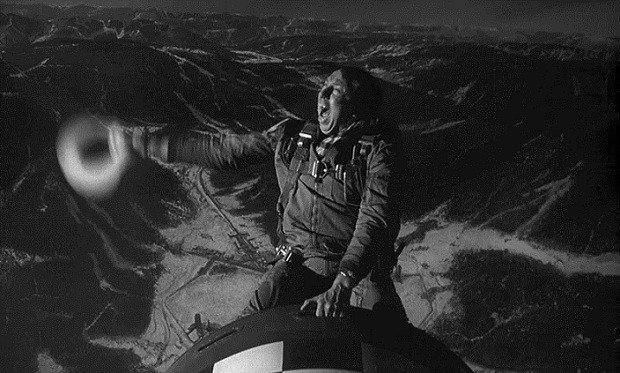
Slim Pickens rides the bomb in 'Dr. Strangelove." No worries.

Slim Pickens rides the bomb in ‘Dr. Strangelove.” No worries.

I was back at the shack, beside myself with angst, reading to Swamp Rabbit about a catastrophe that almost happened a half-century ago:

A secret document, published in declassified form for the first time by the Guardian today, reveals that the US Air Force came dramatically close to detonating an atom bomb over North Carolina that would have been 260 times more powerful than the device that devastated Hiroshima.

The document, obtained by the investigative journalist Eric Schlosser under the Freedom of Information Act, gives the first conclusive evidence that the US was narrowly spared a disaster of monumental proportions when two Mark 39 hydrogen bombs were accidentally dropped over Goldsboro, North Carolina on 23 January 1961. The bombs fell to earth after a B-52 bomber broke up in mid-air, and one of the devices behaved precisely as a nuclear weapon was designed to behave in warfare: its parachute opened, its trigger mechanisms engaged, and only one low-voltage switch prevented untold carnage.

I reminded the rabbit that we live a hop and a skip from Philadelphia. The bomb might have wiped out Philly and the rest of the mid-Atlantic region faster than you could say “Duck and cover.”

“‘Almost’ don’t count,” the rabbit said. He was drinking Wild Turkey and Coke, a rustic concoction that brings out the philosopher in him. “The Germans almost took Stalingrad. Dylan almost died in a motorcycle accident. What’s your point, Odd Man?”

I threw an empty bottle of Guinness at him and said, “The point is that real life is stranger than fiction. Even Stanley Kubrick, in Dr. Strangelove or: How I Learned to Stop Worrying and Love the Bomb, couldn’t have made up a story this strange. If not for one measly switch, that bomb would have gone off.”

The rabbit gulped his drink, spilling some on his greasy coat, and said, “So what, Odd Man? If the bomb had gone off, then you wouldn’t be sitting here worrying out loud like some old lady with rheumatism. That was Kubrick’s point, don’t you know? In an absurd world, why worry?”

I watched the Guinness bottle bobbing in the swamp and said, “You stupid rodent. Dr. Strangelove was a cautionary tale. Kubrick was trying to wise people up to the danger of nuclear war.”

“Dr. Strangelove was a comedy,” he said. “Ain’t no way nobody like you could have done nothin’ about no nuclear war, not when the Cold War was on. You might just as well laugh. If you want to worry, then worry about where you’re gonna sell them stories you write. Worry about where you gonna git money for food now that there ain’t no jobs.”

I almost tossed him in the swamp by his ears but resisted the urge. What good is angst if you don’t have an audience for it?

Posted in arts, economic collapse, fiction, history, humor, mainstream media, movies, Philadelphia, unemployment | Tagged , , , , , | Leave a comment